
Documentation / MCP server
MCP server
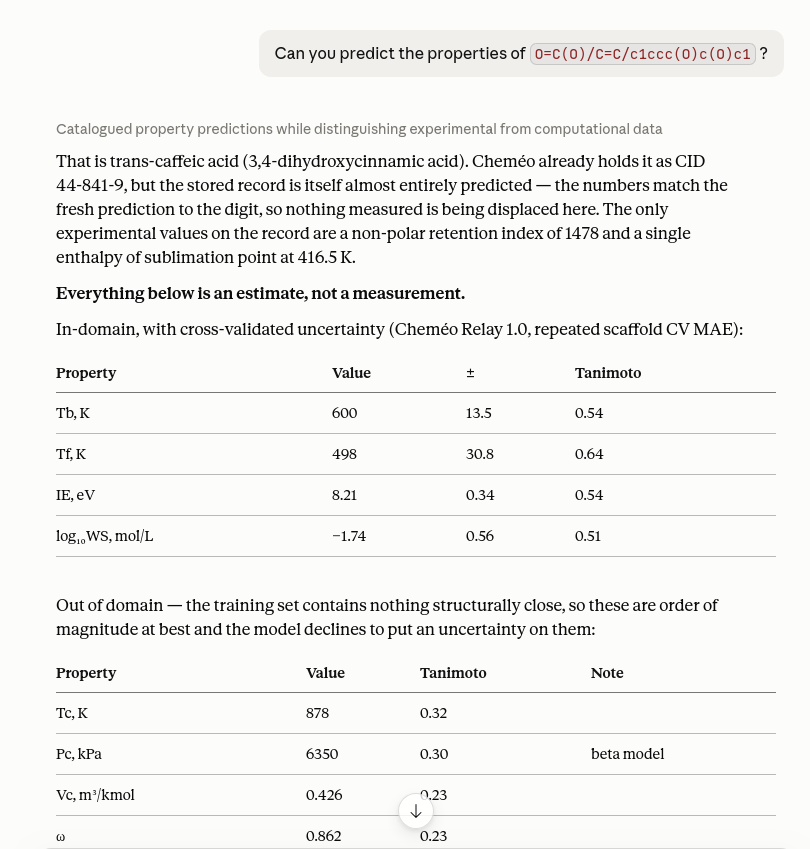
Cheméo runs a Model Context Protocol (MCP) server, so an AI assistant can search the database and read property data directly, with the provenance and confidence a model needs to answer responsibly. It is the counterpart to the REST API: same data, shaped for a model to interpret rather than for a program to parse.
The endpoint
The MCP server is at:
https://www.chemeo.com/api/mcp
Connecting is authorized with your Cheméo account through a standard OAuth flow: the client opens a consent screen, you approve it, and the connection is bound to your account. There is no key to copy and paste.
Connecting a client
In an MCP-capable assistant, add Cheméo as a connector or custom integration and give it the endpoint above. The client discovers the authorization server automatically and walks you through approving access. Once connected, the assistant can call the tools below on your behalf.
The tools
| Tool | What it does |
|---|---|
search_compounds |
search the database, the same search syntax as the site |
get_compound_properties |
the measured properties of a compound, with their sources, and its correlations (equation, coefficients and validity range) |
predict_properties |
estimate properties for a structure, with uncertainty and method |
list_properties |
the property keys Cheméo knows and what they mean |
get_sources |
the sources behind a value, cited |
Why not just the REST API
A program that calls a REST API keeps the fields it expects and discards the rest; it does not interpret. An assistant interprets: it reasons about what a number means, what is missing, and what it can responsibly say. That needs stricter, better-labelled data, not more of it, so the MCP tools carry explicit provenance, explicit units, and an explicit note when a value is predicted or out of domain. Point a model at the raw API and it will sound confident about things it should hedge; the MCP surface is built to prevent exactly that.
Using the data responsibly
Values from Cheméo are experimental measurements and predictions from the database. When an assistant uses one, it should cite the compound page it came from, and it should carry through the uncertainty and the out-of-domain warnings rather than flattening them into a single confident number.