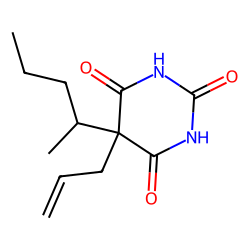
- InChI
- InChI=1S/C12H18N2O3/c1-4-6-8(3)12(7-5-2)9(15)13-11(17)14-10(12)16/h5,8H,2,4,6-7H2,1,3H3,(H2,13,14,15,16,17)
- InChI Key
- KQPKPCNLIDLUMF-UHFFFAOYSA-N
- Formula
- C12H18N2O3
- SMILES
-
C=CCC1(C(C)CCC)C(=O)NC(=O)NC1=
O - Molecular Weight1
- 238.29
- Other Names
-
- (.+/-.))-Secobarbital
- 2,4,6(1H,3H,5H)-Pyrimidinetrione, 5-(1-methylbutyl)-5-(2-propen-1-yl)-
- 2,4,6(1H,3H,5H)-Pyrimidinitrione, 5-(1-methylbutyl)-5-(2-propenyl)-
- 5-(1-Methylbutyl)-5-(2-propen-1-yl)-2,4,6(1H,3H,5H)-pyrimidinetrione (secobarbital)
- 5-Allyl-5-(1-methylbutyl)-2,4,6(1H,3H,5H)-pyrimidinetrione
- 5-Allyl-5-(1-methylbutyl)barbituric acid
- 5-Allyl-5-(1-methylbutyl)malonylurea
- 5-pentan-2-yl-5-prop-2-enyl-1,3-diazinane-2,4,6-trione
- Barbituric acid, 5-allyl-5-(1-methylbutyl)-
- Barbosec
- Evronal
- Hypotrol
- Immenox
- Meballymal
- Quinalbarbital
- Quinalbarbitone
- Secobarbital
- Secobarbitone
- Seconal
- Cp,gas : Ideal gas heat capacity (J/mol×K).
- ΔfusH° : Enthalpy of fusion at standard conditions (kJ/mol).
- ΔfusH : Enthalpy of fusion at a given temperature (kJ/mol).
- log10WS : Log10 of Water solubility in mol/l.
- logPoct/wat : Octanol/Water partition coefficient.
- McVol : McGowan's characteristic volume (ml/mol).
- Inp : Non-polar retention indices.
- Tfus : Normal melting (fusion) point (K).
- 1: Molecular weight from the IUPAC atomic weights tables.
Physical Properties
| Property | Value | Unit | Source |
|---|---|---|---|
| ΔfusH° | 25.28 | kJ/mol | Joback Calculated Property |
| log10WS | [-2.36; -2.36] |

|
|
| log10WS | -2.36 | Aq. Solubility Prediction | |
| log10WS | -2.36 | Estimated Solubility | |
| logPoct/wat | 1.351 | Crippen Calculated Property | |
| McVol | 189.450 | ml/mol | McGowan Calculated Property |
| Inp | [1757.00; 1831.30] |
|
|
| Inp | 1810.00 | NISTMSDC-RI | |
| Inp | 1790.00 | NISTMSDC-RI | |
| Inp | 1795.00 | NISTMSDC-RI | |
| Inp | 1810.00 | NIST Phillips, Logan, et al., 1990 | |
| 15. m/0.25 mm/0.2 «mu»m, He | |||
| Inp | 1772.00 | NIST Japp, Gill, et al., 1987 | |
| 25. m/0.22 mm/0.25 «mu»m, N2 | |||
| Inp | 1777.00 | NIST Japp, Gill, et al., 1987 | |
| 25. m/0.53 mm/1. «mu»m, N2 | |||
| Inp | 1786.00 | NIST Lora-Tamayo, Rams, et al., 1986 | |
| He; Column length: 25. m; Column diameter: 0.20 mm | |||
| Inp | 1770.00 | NISTStead, Gill, et al., 1982 | |
| Inp | 1790.00 | NISTBerninger and Möller, 1977 | |
| Inp | 1790.00 | NIST Möller, 1976 | |
| N2, Chromosorb G AW DMCS (80-100 mesh); Column length: 2. m | |||
| Inp | 1795.00 | NIST Möller, 1976 | |
| N2, Chromosorb G AW DMCS (80-100 mesh); Column length: 2. m | |||
| Inp | 1815.00 | NIST Möller, 1976 | |
| N2, Chromosorb G AW DMCS (80-100 mesh); Column length: 2. m | |||
| Inp | 1795.00 | NIST Maurer, 1990 | |
| N2, 100. C @ 3. min, 30. K/min, 310. C @ 5. min | |||
| Inp | 1768.00 | NIST Schepers, Wijsbeek, et al., 1982 | |
| 25. m/0.49 mm/1.14 «mu»m, 100. C @ 2. min, 8. K/min, 275. C @ 15. min | |||
| Inp | 1820.00 | NIST McLinden and Stenhouse, 1979 | |
| N2, Chromosorb W; Column length: 2. m; Program: not specified | |||
| Inp | Outlier 1831.30 | NIST Tretyakov, 2014 | |
| 30. m/0.25 mm/0.25 «mu»m, He; Tstart: 60. C; Tend: 270. C | |||
| Inp | 1791.00 | NIST Christ, Noomano, et al., 1988 | |
| 30. m/0.75 mm/1.0 «mu»m, He, 10. K/min, 280. C @ 12. min; Tstart: 160. C | |||
| Inp | 1769.00 | NIST Perrigo, Peel, et al., 1985 | |
| 15. m/0.32 mm/0.25 «mu»m, He, 8. K/min, 280. C @ 5. min; Tstart: 120. C | |||
| Inp | 1763.00 | NIST Newton and Foery, 1984 | |
| 12. m/0.2 mm/0.33 «mu»m, He, 50. C @ 1. min, 20. K/min, 300. C @ 3. min | |||
| Inp | 1813.00 | NIST Newton and Foery, 1984 | |
| 12. m/0.2 mm/0.33 «mu»m, He, 50. C @ 1. min, 20. K/min, 300. C @ 3. min | |||
| Inp | 1769.00 | NIST Perrigo, Ballantyne, et al., 1984 | |
| 15. m/0.25 mm/0.25 «mu»m, He, 8. K/min, 280. C @ 5. min; Tstart: 120. C | |||
| Inp | 1790.00 | NIST Perrigo and Peel, 1981 | |
| N2, Chromosorb W, 130. C @ 2. min, 8. K/min, 290. C @ 8. min; Column length: 1.8 m | |||
| Inp | 1763.00 | NIST Stowell and Wilson, 1987 | |
| 12. m/0.22 mm/0.25 «mu»m, He; Program: 120C => 8C/min => 270C => 25C/min => 300C | |||
| Inp | 1775.00 | NIST Möller, 1976 | |
| N2, Chromosorb G AW DMCS (80-100 mesh); Column length: 2. m | |||
| Inp | 1770.00 | NIST MHA, 9999 | |
| Tstart: 100. C; Tend: 300. C | |||
| Inp | 1757.00 | NIST Anderson and Fuller, 1987 | |
| 10. m/0.53 mm/2.65 «mu»m, He, 5. K/min; Tstart: 130. C; Tend: 230. C | |||
| Inp | 1766.00 | NIST Sharp, 1987 | |
| 15. m/0.25 mm/0.25 «mu»m, He, 130. C @ 1. min, 10. K/min, 290. C @ 10. min | |||
| Inp | 1769.00 | NIST Stowell and Wilson, 1985 | |
| 12. m/0.22 mm/0.25 «mu»m, He, 8. K/min; Tstart: 120. C; Tend: 280. C | |||
| Inp | 1763.00 | NIST Stowell and Wilson, 1985 | |
| 12. m/0.22 mm/0.25 «mu»m, He, 20. K/min; Tstart: 50. C; Tend: 300. C | |||
| Inp | 1770.00 | NIST Marozzi, Gambaro, et al., 1982 | |
| Gas Chrom P, 2.5 K/min; Column length: 2. m; Tstart: 120. C; Tend: 200. C | |||
| Inp | 1788.00 | NIST Peel and Perrigo, 1976 | |
| Nitrogen, Chromosorb W AW DMS (80-100 mesh), 130. C @ 2. min, 8. K/min, 290. C @ 8. min; Column length: 2. m | |||
| Inp | 1788.00 | NIST Peel and Perrigo, 1975 | |
| N2, Chromosorb W AW DMS, 130. C @ 2. min, 8. K/min, 290. C @ 8. min; Column length: 2. m | |||
| Inp | 1763.00 | NIST Stowell and Wilson, 1985 | |
| 12. m/0.22 mm/0.25 «mu»m, He; Program: 120 0X 8 0C/min -> 270 0C 25 0C/min -> 300 0C (5 min) | |||
| Inp | 1775.00 | NIST Stowell and Wilson, 1985 | |
| 12. m/0.22 mm/0.25 «mu»m, He; Program: not specified | |||
| Inp | 1786.00 | NIST Waggott and Davies, 1984 | |
| Hydrogen; Column length: 50. m; Column diameter: 0.32 mm; Program: not specified | |||
| Inp | 1791.00 | NIST Ardrey and Moffat, 1981 | |
| Program: not specified | |||
| Inp | 1790.00 | NIST Ardrey and Moffat, 1981 | |
| Program: not specified | |||
| Inp | 1770.00 | NISTMSDC-RI | |
| Inp | Outlier 1831.30 | NISTMSDC-RI | |
| Inp | 1769.00 | NISTMSDC-RI | |
| Inp | 1763.00 | NISTMSDC-RI | |
| Inp | 1820.00 | NISTMSDC-RI | |
| Inp | 1775.00 | NISTMSDC-RI | |
| Tfus | [356.70; 373.15] | K |
|
| Tfus | 373.15 | K | Jean-Claude Bradley Open Melting Point Dataset (2014, CC0) Compiled value |
| Tfus | 370.65 | K | Aq. Solubility Prediction |
| Tfus | 356.70 ± 2.00 | K | NIST Kuffner, Bush, et al., 1957 |
| not clear that this was measured by author | |||

Cheméo can also estimate Normal Boiling Point Temperature, Critical Temperature, Critical Pressure, Critical Volume, Enthalpy of formation at standard conditions, Enthalpy of vaporization at standard conditions, Standard Gibbs free energy of formation, Acentric Factor, Ionization energy for this compound, but they fall outside the models' validated range, so they are not shown here. Open the prediction tool to compute them on demand.
Temperature Dependent Properties
| Property | Value | Unit | Temperature (K) | Source |
|---|---|---|---|---|
| ΔfusH | 22.90 | kJ/mol | 371.80 | NISTWassvik, Holmén, et al., 2008 |
Correlations
| Property | Value | Unit | Temperature (K) | Source |
|---|---|---|---|---|
| Cp,gas | [261.21; 662.68] | J/mol×K | [273.00; 1000.00] |
Joback Predicted correlation
|
| Equation | Y = A + B·T + C·T² + D·T³ + E·T⁴ Y is Cp,gas in J/mol×K, T in K | |||
| Coefficient A | 1.48430e+01 | |||
| Coefficient B | 1.01204e+00 | |||
| Coefficient C | -4.15500e-04 | |||
| Coefficient D | 5.13000e-08 | |||
| Coefficient E | 0.00000e+00 | |||
| Temperature range, min. | 273.00 | |||
| Temperature range, max. | 1000.00 | |||
| Cp,gas | 261.21 | J/mol×K | 273.00 | Calculated Property |
| Cp,gas | 323.15 | J/mol×K | 353.78 | Calculated Property |
| Cp,gas | 380.38 | J/mol×K | 434.56 | Calculated Property |
| Cp,gas | 433.06 | J/mol×K | 515.33 | Calculated Property |
| Cp,gas | 481.35 | J/mol×K | 596.11 | Calculated Property |
| Cp,gas | 525.42 | J/mol×K | 676.89 | Calculated Property |
| Cp,gas | 565.42 | J/mol×K | 757.67 | Calculated Property |
| Cp,gas | 601.53 | J/mol×K | 838.44 | Calculated Property |
| Cp,gas | 633.89 | J/mol×K | 919.22 | Calculated Property |
| Cp,gas | 662.68 | J/mol×K | 1000.00 | Calculated Property |
Similar Compounds


Find more compounds similar to 2,4,6(1H,3H,5H)-Pyrimidinetrione, 5-(1-methylbutyl)-5-(2-propenyl)-.
Sources
- Jean-Claude Bradley Open Melting Point Dataset (2014, CC0) ChEDL chemicals 1.5.2, from Bradley, J.-C.; Williams, A.; Lang, A. Jean-Claude Bradley Open Melting Point Dataset. Figshare, 2014 (CC0).
- Cheméo Relay (1.0, beta) Beta: served but experimental, data-limited and below our cross-validation release bar; the Joback value is recommended where available.
- Crippen Method
- Joback Method
- Aqueous Solubility Prediction Method
- Estimated Solubility Method
- McGowan Method
- NIST Webbook
Note: Cheméo is only indexing the data, follow the source links to retrieve the latest data. The source is also providing more information like the publication year, authors and more.
Take the time to validate and double check the source of the data.
Outlier This icon means
that the value is more than 2 standard deviations away from the
property mean.
Calculated This icon marks a calculated value or equation: a prediction, not a measurement.
Compiled This icon marks a compiled value or equation: taken from a data compilation such as ChemSep, not from an original measurement report.
These property values are available through the Cheméo API. A free account gives you an access key.