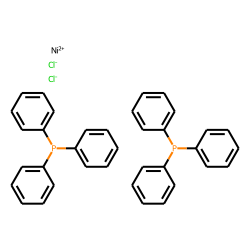
- InChI
- InChI=1S/2C18H15P.2ClH.Ni/c2*1-4-10-16(11-5-1)19(17-12-6-2-7-13-17)18-14-8-3-9-15-18;;;/h2*1-15H;2*1H;/q;;;;+2/p-2
- InChI Key
- ZBRJXVVKPBZPAN-UHFFFAOYSA-L
- Formula
- C36H30Cl2NiP2
- SMILES
-
[Cl-].[Cl-].[Ni+2].c1ccc(P(c2c
cccc2)c2ccccc2)cc1.c1ccc(P(c2c cccc2)c2ccccc2)cc1 - Molecular Weight1
- 654.17
- CAS
- 14264-16-5
- Other Names
-
- dichlorobis(triphenylphosphine)nickel
- IE : Ionization energy (eV).
- Tfus : Normal melting (fusion) point (K).
- 1: Molecular weight from the IUPAC atomic weights tables.
Physical Properties
| Property | Value | Unit | Source |
|---|---|---|---|
| IE | 7.57 | eV | Relay (1.0) Calculated Property |
| Tfus | 474.61 | K | Relay (1.0) Calculated Property |
Cheméo can also estimate Normal Boiling Point Temperature, Critical Temperature, Critical Pressure, Critical Volume, Enthalpy of formation at standard conditions, Enthalpy of vaporization at standard conditions, Standard Gibbs free energy of formation, Acentric Factor, Log10 of Water solubility in mol/l for this compound, but they fall outside the models' validated range, so they are not shown here. Open the prediction tool to compute them on demand.
Similar Compounds


Find more compounds similar to bis(triphenylphosphine)nickel(II) chloride.
Sources
- Cheméo Relay (1.0)
- Cheméo Relay (1.0, beta) Beta: served but experimental, data-limited and below our cross-validation release bar; the Joback value is recommended where available.
- NIST Webbook
Note: Cheméo is only indexing the data, follow the source links to retrieve the latest data. The source is also providing more information like the publication year, authors and more.
Take the time to validate and double check the source of the data.
These property values are available through the Cheméo API. A free account gives you an access key.