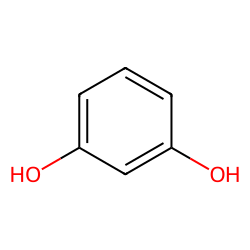
- InChI
- InChI=1S/C6H6O2/c7-5-2-1-3-6(8)4-5/h1-4,7-8H
- InChI Key
- GHMLBKRAJCXXBS-UHFFFAOYSA-N
- Formula
- C6H6O2
- SMILES
- Oc1cccc(O)c1
- Molecular Weight1
- 110.11
- CAS
- 108-46-3
- Other Names
-
- 1,3-Dihydroxybenzene (resorcinol)
- 1,3-benzenediol
- 1,3-dihydroxybenzene
- 3-hydroxyphenol
- Benzene, 1,3-dihydroxy-
- Benzene, m-dihydroxy-
- C.I. 76505
- C.I. Developer 4
- C.I. Oxidation Base 31
- Developer O
- Developer R
- Developer RS
- Durafur Developer G
- Fouramine RS
- Fourrine 79
- Fourrine EW
- NCI-C05970
- NSC 1571
- Nako TGG
- Pelagol Grey RS
- Pelagol RS
- Phenol, m-hydroxy-
- Rcra waste number U201
- Resorcin
- Resorcine
- Rodol RS
- UN 2876
- m-Dioxybenzene
- m-Hydroquinone
- m-Hydroxyphenol
- m-benzenediol
- m-dihydroxybenzene
- «alpha»-Resorcinol
- ω : Acentric Factor.
- PAff : Proton affinity (kJ/mol).
- ΔcH°solid : Standard solid enthalpy of combustion (kJ/mol).
- Cp,gas : Ideal gas heat capacity (J/mol×K).
- Cp,solid : Solid phase heat capacity (J/mol×K).
- η : Dynamic viscosity (Pa×s).
- SProt : Protonation entropy at 298K (J/mol×K).
- ΔfG° : Standard Gibbs free energy of formation (kJ/mol).
- ΔfH°gas : Enthalpy of formation at standard conditions (kJ/mol).
- ΔfH°solid : Solid phase enthalpy of formation at standard conditions (kJ/mol).
- ΔfusH° : Enthalpy of fusion at standard conditions (kJ/mol).
- ΔfusH : Enthalpy of fusion at a given temperature (kJ/mol).
- ΔsubH° : Enthalpy of sublimation at standard conditions (kJ/mol).
- ΔsubH : Enthalpy of sublimation at a given temperature (kJ/mol).
- ΔvapH° : Enthalpy of vaporization at standard conditions (kJ/mol).
- ΔvapH : Enthalpy of vaporization at a given temperature (kJ/mol).
- IE : Ionization energy (eV).
- log10WS : Log10 of Water solubility in mol/l.
- logPoct/wat : Octanol/Water partition coefficient.
- McVol : McGowan's characteristic volume (ml/mol).
- NFPA Fire : NFPA Fire Rating.
- Pc : Critical Pressure (kPa).
- Psub : Sublimation pressure (kPa).
- Pvap : Vapor pressure (kPa).
- Inp : Non-polar retention indices.
- ΔfusS : Entropy of fusion at a given temperature (J/mol×K).
- γ : Surface Tension (N/m).
- Tboil : Normal Boiling Point Temperature (K).
- Tboil(P) : Boiling point at given pressure (K).
- Tboilr : Boiling point at reduced pressure (K).
- Tc : Critical Temperature (K).
- Tfus : Normal melting (fusion) point (K).
- Ttriple : Triple Point Temperature (K).
- Vc : Critical Volume (m3/kmol).
- 1: Molecular weight from the IUPAC atomic weights tables.
Cheméo is a service of Céondo GmbH, since 2007, we provide simulation, modelling and software development services for the industry.
Do not hesitate to contact us for your projects.
Physical Properties
| Property | Value | Unit | Source |
|---|---|---|---|
| ω | 0.6413 | PSRK revision IV (2005), critical constants and acentric factors of 1000 components Compiled value | |
| PAff | 856.40 | kJ/mol | NIST |
| ΔcH°solid | [-2867.00; -2847.90] | kJ/mol |

|
| ΔcH°solid | -2847.90 ± 1.10 | kJ/mol | NIST |
| ΔcH°solid | -2850.60 ± 0.42 | kJ/mol | NIST |
| ΔcH°solid | -2867.00 | kJ/mol | NIST |
| ΔcH°solid | -2861.00 | kJ/mol | NIST |
| SProt | -15.00 | J/mol×K | NIST |
| ΔfG° | -187.56 | kJ/mol | Joback Calculated Property |
| ΔfH°gas | [-284.70; -265.20] | kJ/mol |
|
| ΔfH°gas | -284.70 ± 1.20 | kJ/mol | NIST |
| ΔfH°gas | -275.00 | kJ/mol | NIST |
| ΔfH°gas | -265.20 | kJ/mol | NIST |
| ΔfH°solid | [-370.70; -351.20] | kJ/mol |
|
| ΔfH°solid | -370.70 ± 1.10 | kJ/mol | NIST |
| ΔfH°solid | -368.00 ± 0.50 | kJ/mol | NIST |
| ΔfH°solid | -351.20 | kJ/mol | NIST |
| ΔfusH° | 17.29 | kJ/mol | Joback Calculated Property |
| ΔsubH° | [86.00; 93.00] | kJ/mol |
|
| ΔsubH° | 86.00 ± 0.52 | kJ/mol | NIST |
| ΔsubH° | 86.00 | kJ/mol | NIST |
| ΔsubH° | 87.50 ± 0.50 | kJ/mol | NIST |
| ΔsubH° | Outlier 93.00 | kJ/mol | NIST |
| ΔsubH° | 86.00 ± 0.52 | kJ/mol | NIST |
| ΔsubH° | 86.00 | kJ/mol | NIST |
| ΔsubH° | 87.50 ± 0.50 | kJ/mol | NIST |
| ΔvapH° | 78.40 ± 1.30 | kJ/mol | NIST |
| IE | [8.20; 8.63] | eV |
|
| IE | 8.20 | eV | NIST |
| IE | 8.63 | eV | NIST |
| log10WS | [0.81; 0.81] |
|
|
| log10WS | 0.81 | Aq. Solubility Prediction | |
| log10WS | 0.81 | Estimated Solubility | |
| logPoct/wat | 1.098 | Crippen Calculated Property | |
| McVol | 83.380 | ml/mol | McGowan Calculated Property |
| NFPA Fire | 1 | KDB | |
| Pc | [6240.00; 6750.27] | kPa |
|
| Pc | 6240.00 | kPa | Critical Point and Vapor Pressure Measurements for Four Compounds by a Low Residence Time Flow Method |
| Pc | 6750.27 | kPa | PSRK revision IV (2005), critical constants and acentric factors of 1000 components Compiled value |
| Inp | [213.50; 1379.00] |
|
|
| Inp | 1379.00 | NIST | |
| Inp | 1376.00 | NIST | |
| Inp | 1368.00 | NIST | |
| Inp | 1368.00 | NIST | |
| Inp | 213.50 | NIST | |
| Inp | 216.79 | NIST | |
| Inp | 219.64 | NIST | |
| Inp | 213.50 | NIST | |
| Inp | 1368.00 | NIST | |
| Inp | 1376.00 | NIST | |
| Tboil | [549.05; 554.55] | K |
|
| Tboil | 549.05 | K | KDB |
| Tboil | 550.00 | K | NIST |
| Tboil | 549.10 ± 0.40 | K | NIST |
| Tboil | 554.55 ± 0.50 | K | NIST |
| Tc | 810.00 | K | PSRK revision IV (2005), critical constants and acentric factors of 1000 components Compiled value |
| Tfus | [381.00; 390.00] | K |
|
| Tfus | 383.15 | K | Liquid pharmaceuticals formulation by eutectic formation |
| Tfus | 382.00 | K | Enthalpies of formation of dihydroxybenzenes revisited: Combining experimental and high-level ab initio data |
| Tfus | 382.20 | K | The fusion thermochemistry of self-associated aromatic compounds at 298.15 K studied by solution calorimetry |
| Tfus | 383.65 | K | Thermal, physicochemical and microstructural studies of organic analog of nonmetal-nonmetal monotectic alloy |
| Tfus | 384.15 | K | Jean-Claude Bradley Open Melting Point Dataset (2014, CC0) Compiled value |
| Tfus | 382.85 | K | KDB |
| Tfus | 383.90 | K | Aq. Solubility Prediction |
| Tfus | 382.60 ± 0.50 | K | NIST |
| Tfus | 384.00 | K | NIST |
| Tfus | 381.00 ± 1.00 | K | NIST |
| Tfus | 382.00 ± 1.00 | K | NIST |
| Tfus | 383.50 ± 0.30 | K | NIST |
| Tfus | Outlier 390.00 ± 1.50 | K | NIST |
| Tfus | 381.95 ± 0.50 | K | NIST |
| Ttriple | [382.70; 383.54] | K |
|
| Ttriple | 383.54 ± 0.02 | K | NIST |
| Ttriple | 382.70 ± 0.20 | K | NIST |
| Ttriple | 382.80 ± 0.25 | K | NIST |
| Ttriple | 383.54 ± 0.02 | K | NIST |
| Ttriple | 382.80 ± 0.25 | K | NIST |
| Vc | 0.292 | m3/kmol | PSRK revision IV (2005), critical constants and acentric factors of 1000 components Compiled value |

Temperature Dependent Properties
Pressure Dependent Properties
| Property | Value | Unit | Pressure (kPa) | Source |
|---|---|---|---|---|
| Tboil(P) | [444.70; 456.80] | K | [2.95; 4.93] |
|
| Tboil(P) | 444.70 | K | 2.95 | Vapour pressure data for 2-n-propylresorcinol, 4-ethylresorcinol and 4-hexylresorcinol near their normal boiling points measured by differential scanning calorimetry |
| Tboil(P) | 451.30 | K | 3.93 | Vapour pressure data for 2-n-propylresorcinol, 4-ethylresorcinol and 4-hexylresorcinol near their normal boiling points measured by differential scanning calorimetry |
| Tboil(P) | 456.80 | K | 4.93 | Vapour pressure data for 2-n-propylresorcinol, 4-ethylresorcinol and 4-hexylresorcinol near their normal boiling points measured by differential scanning calorimetry |
| Tboilr | 451.20 | K | 2.10 | NIST |
Correlations
| Property | Value | Unit | Temperature (K) | Source |
|---|---|---|---|---|
| Cp,gas | [106.73; 258.23] | J/mol×K | [273.00; 1000.00] |
Joback Predicted correlation
|
| Equation | Y = A + B·T + C·T² + D·T³ + E·T⁴ Y is Cp,gas in J/mol×K, T in K | |||
| Coefficient A | -6.86100e+01 | |||
| Coefficient B | 8.63600e-01 | |||
| Coefficient C | -9.13560e-04 | |||
| Coefficient D | 3.76800e-07 | |||
| Coefficient E | 0.00000e+00 | |||
| Temperature range, min. | 273.00 | |||
| Temperature range, max. | 1000.00 | |||
| Cp,gas | 106.73 | J/mol×K | 273.00 | Calculated Property |
| Cp,gas | 139.26 | J/mol×K | 353.78 | Calculated Property |
| Cp,gas | 165.08 | J/mol×K | 434.56 | Calculated Property |
| Cp,gas | 185.39 | J/mol×K | 515.33 | Calculated Property |
| Cp,gas | 201.38 | J/mol×K | 596.11 | Calculated Property |
| Cp,gas | 214.24 | J/mol×K | 676.89 | Calculated Property |
| Cp,gas | 225.16 | J/mol×K | 757.67 | Calculated Property |
| Cp,gas | 235.34 | J/mol×K | 838.44 | Calculated Property |
| Cp,gas | 245.97 | J/mol×K | 919.22 | Calculated Property |
| Cp,gas | 258.23 | J/mol×K | 1000.00 | Calculated Property |
| Property | Value | Unit | Temperature (K) | Source |
|---|---|---|---|---|
| η | [0.0015372; 0.0000096] | Pa×s | [382.84; 567.00] |
Joback Predicted correlation
|
| Equation | Y = exp(A + B/T + C·ln(T) + D·T^E) Y is η in Pa×s, T in K | |||
| Coefficient A | -2.21125e+01 | |||
| Coefficient B | 5.98564e+03 | |||
| Coefficient C | 0.00000e+00 | |||
| Coefficient D | 0.00000e+00 | |||
| Coefficient E | 0.00000e+00 | |||
| Comment | Liquid phase. Joback/Reid (1987), valid from Tf to 0.7·Tc. | |||
| Temperature range, min. | 382.84 | |||
| Temperature range, max. | 567.00 | |||
| η | 0.0015372 | Pa×s | 382.84 | Calculated Property |
| η | 0.0006954 | Pa×s | 403.30 | Calculated Property |
| η | 0.0003396 | Pa×s | 423.77 | Calculated Property |
| η | 0.0001772 | Pa×s | 444.23 | Calculated Property |
| η | 0.0000979 | Pa×s | 464.69 | Calculated Property |
| η | 0.0000569 | Pa×s | 485.15 | Calculated Property |
| η | 0.0000345 | Pa×s | 505.61 | Calculated Property |
| η | 0.0000218 | Pa×s | 526.08 | Calculated Property |
| η | 0.0000142 | Pa×s | 546.54 | Calculated Property |
| η | 0.0000096 | Pa×s | 567.00 | Calculated Property |
| Property | Value | Unit | Temperature (K) | Source |
|---|---|---|---|---|
| Pvap | [0.09; 7618.13] | kPa | [382.00; 810.00] |
KDB Vapor Pressure Data
|
| Equation | ln(Y) = A + B/T + C·ln(T) + D·T² + E/T² Y is Pvap in kPa, T in K | |||
| Coefficient A | 1.64521e+02 | |||
| Coefficient B | -1.68432e+04 | |||
| Coefficient C | -2.08308e+01 | |||
| Coefficient D | 7.18739e-06 | |||
| Coefficient E | 0.00000e+00 | |||
| Temperature range, min. | 382.00 | |||
| Temperature range, max. | 810.00 | |||
| Pvap | 0.09 | kPa | 382.00 | Calculated Property |
| Pvap | 1.41 | kPa | 429.56 | Calculated Property |
| Pvap | 10.76 | kPa | 477.11 | Calculated Property |
| Pvap | 51.35 | kPa | 524.67 | Calculated Property |
| Pvap | 176.66 | kPa | 572.22 | Calculated Property |
| Pvap | 481.64 | kPa | 619.78 | Calculated Property |
| Pvap | 1111.85 | kPa | 667.33 | Calculated Property |
| Pvap | 2278.49 | kPa | 714.89 | Calculated Property |
| Pvap | 4290.69 | kPa | 762.44 | Calculated Property |
| Pvap | 7618.13 | kPa | 810.00 | Calculated Property |
| Pvap | [1.29; 102.51] | kPa | [424.70; 549.70] |
NIST
|
| Equation | ln(Y) = A + B/(T + C) Y is Pvap in kPa, T in K | |||
| Coefficient A | 1.73212e+01 | |||
| Coefficient B | -6.18740e+03 | |||
| Coefficient C | -6.21640e+01 | |||
| Reference | von Terres, Gebert, et al., 1955 | |||
| Comment | Coefficents calculated by NIST from author's data. | |||
| Temperature range, min. | 424.70 | |||
| Temperature range, max. | 549.70 | |||
| Pvap | 1.29 | kPa | 424.70 | Calculated Property |
| Pvap | 2.42 | kPa | 438.59 | Calculated Property |
| Pvap | 4.34 | kPa | 452.48 | Calculated Property |
| Pvap | 7.49 | kPa | 466.37 | Calculated Property |
| Pvap | 12.45 | kPa | 480.26 | Calculated Property |
| Pvap | 20.04 | kPa | 494.14 | Calculated Property |
| Pvap | 31.31 | kPa | 508.03 | Calculated Property |
| Pvap | 47.62 | kPa | 521.92 | Calculated Property |
| Pvap | 70.66 | kPa | 535.81 | Calculated Property |
| Pvap | 102.51 | kPa | 549.70 | Calculated Property |
| Property | Value | Unit | Temperature (K) | Source |
|---|---|---|---|---|
| γ | [0.05; 0.04] | N/m | [383.15; 549.15] |
Jasper (1972), surface tension of pure liquid compounds Compiled value
|
| Equation | Y = A + B·T + C·T² + D·T³ + E·T⁴ Y is γ in N/m, T in K | |||
| Coefficient A | 7.43849e-02 | |||
| Coefficient B | -7.17000e-05 | |||
| Coefficient C | 0.00000e+00 | |||
| Coefficient D | 0.00000e+00 | |||
| Coefficient E | 0.00000e+00 | |||
| Temperature range, min. | 383.15 | |||
| Temperature range, max. | 549.15 | |||
| γ | 0.05 | N/m | 383.15 | Calculated Property |
| γ | 0.05 | N/m | 401.59 | Calculated Property |
| γ | 0.04 | N/m | 420.04 | Calculated Property |
| γ | 0.04 | N/m | 438.48 | Calculated Property |
| γ | 0.04 | N/m | 456.93 | Calculated Property |
| γ | 0.04 | N/m | 475.37 | Calculated Property |
| γ | 0.04 | N/m | 493.82 | Calculated Property |
| γ | 0.04 | N/m | 512.26 | Calculated Property |
| γ | 0.04 | N/m | 530.71 | Calculated Property |
| γ | 0.04 | N/m | 549.15 | Calculated Property |
Similar Compounds


Find more compounds similar to Resorcinol.
Mixtures
- Resorcinol + Choline chloride
- Resorcinol + Benzene, 1,4-diiodo-
- Resorcinol + 2-Butanone, 3-methyl- + Water
- Resorcinol + Water
- Resorcinol + Carbon dioxide
- Resorcinol + Carbon dioxide + 1,2-Benzenediol
- Methyl Isobutyl Ketone + Resorcinol + Water
- Resorcinol + Water + Niacinamide
- Resorcinol + 2-Octanone + Water
- Resorcinol + 2-Pentanone + Water
- Resorcinol + Ethanol
- 1-Propanol + Resorcinol
- Resorcinol + 1-Butanol
Sources
- KDB Vapor Pressure Data
- Jean-Claude Bradley Open Melting Point Dataset (2014, CC0) ChEDL chemicals 1.5.2, from Bradley, J.-C.; Williams, A.; Lang, A. Jean-Claude Bradley Open Melting Point Dataset. Figshare, 2014 (CC0).
- Jasper (1972), surface tension of pure liquid compounds ChEDL chemicals 1.5.2, from Jasper, J. J. The Surface Tension of Pure Liquid Compounds. J. Phys. Chem. Ref. Data 1972, 1, 841-1010 (as transcribed in Lange's Handbook).
- PSRK revision IV (2005), critical constants and acentric factors of 1000 components ChEDL chemicals 1.5.2, from Horstmann, S.; Jabłoniec, A.; Krafczyk, J.; Fischer, K.; Gmehling, J. PSRK Group Contribution Equation of State: Comprehensive Revision and Extension IV, Including Critical Constants and α-Function Parameters for 1000 Components. Fluid Phase Equilib. 2005, 227, 157-164.
- Crippen Method
- Partial Molar Volumes and Viscosity B-Coefficients of Nicotinamide in Aqueous Resorcinol Solutions at T=(298.15, 308.15, and 318.15)K
- Ternary liquid-liquid equilibria for methyl isopropyl ketone + (resorcinol or hydroquinone) + water systems at different temperatures
- Liquid-liquid equilibrium for ternary systems, methyl isobutyl ketone +(catechol, resorcinol and hydroquinone) + water at 333.15 K, 343.15 K and 353.15 K
- Liquid pharmaceuticals formulation by eutectic formation
- Heat capacities of aqueous polar aromatic compounds over a wide range of conditions. Part II: dihydroxybenzenes, aminophenols, diaminobenzenes
- Effects of structural isomerism on solution behaviour of solutes: Apparent molar volumes and isentropic compression of catechol, resorcinal, and hydroquinone in aqueous solution at T = (283.15, 293.15, 298.15, 303.15, and 313.15) K
- Enthalpies of formation of dihydroxybenzenes revisited: Combining experimental and high-level ab initio data
- Experimental result and data correlation of liquid-liquid equilibrium for methyl isopropyl ketone + o, m, p-dihydroxybenzene + water at 333.15 K, 343.15 K and 353.15 K
- Vapour pressure data for 2-n-propylresorcinol, 4-ethylresorcinol and 4-hexylresorcinol near their normal boiling points measured by differential scanning calorimetry
- The fusion thermochemistry of self-associated aromatic compounds at 298.15 K studied by solution calorimetry
- Di-Hydroxybenzenes: Catechol, Resorcinol, and Hydroquinone. Enthalpies of Phase Transitions Revisited
- Thermal, physicochemical and microstructural studies of organic analog of nonmetal-nonmetal monotectic alloy
- Solubilities of resorcinol and pyrocathecol and their mixture in supercritical carbon dioxide
- Analysis of solute-pyridine intermolecular interactions based on experimental enthalpies of solution and enthalpies of solvation of solutes dissolved in pyridine
- Liquid-Liquid Equilibria for Ternary (Methyl Propyl Ketone + Hydroquinone or Resorcinol + Water) Systems at 298.15, 318.15, and 333.15 K
- Liquid Liquid Equilibria for Octan-2-one + Dihydroxybenzene + Water at Different Temperatures: Experimental Data and Thermodynamic Modeling
- Measurements and Thermodynamic Modeling of Liquid-Liquid Equilibria Data for the Ternary (Methyl Propyl Ketone + Catechol/Resorcinol/Hydroquinone + Water) Systems
- Critical Point and Vapor Pressure Measurements for Four Compounds by a Low Residence Time Flow Method
- Densities and Viscosities of Binary Solutions of Benzene-1,3-diol + Water, Ethanol, Propan-1-ol, and Butan-1-ol at T = (293.15 to 333.15) K
- Liquid Liquid Equilibria for the Ternary System Methyl Isobutyl Ketone + m-Benzenediol + Water
- Joback Method
- KDB
- Aqueous Solubility Prediction Method
- Estimated Solubility Method
- McGowan Method
- NIST Webbook
Note: Cheméo is only indexing the data, follow the source links to retrieve the latest data. The source is also providing more information like the publication year, authors and more.
Take the time to validate and double check the source of the data.
Outlier This icon means
that the value is more than 2 standard deviations away from the
property mean.
Calculated This icon marks a calculated value or equation: a prediction, not a measurement.
Compiled This icon marks a compiled value or equation: taken from a data compilation such as ChemSep, not from an original measurement report.
These property values are available through the Cheméo API. A free account gives you an access key.