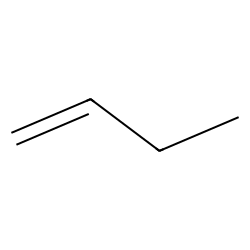
Cheméo RefData 1.0
One consistent value set for simulation, built from chemeo v31.
- Formula
- C4H8
- CAS
- 106-98-9
- Molecular Weight
- 56.11 g/mol
- SMILES
- C=CCC
- InChI Key
- VXNZUUAINFGPBY-UHFFFAOYSA-N
Constants
| Property | Value | Unit | u95 | Basis | Sources |
|---|---|---|---|---|---|
| MW Molecular Weight |
56.11 | g/mol | derived | ||
| Tc Critical Temperature |
419.50 | K | 1.14 | experimental | Air Liquide Gas Encyclopedia; KDB; NIST Webbook; literature: 1 |
| Pc Critical Pressure |
4005.10 | kPa | 91.65 | experimental | Air Liquide Gas Encyclopedia; KDB; NIST Webbook; literature: 1, 2 |
| Vc Critical Volume |
0.241 | m3/kmol | 0.014 | experimental | KDB; NIST Webbook |
| Zc Critical Compressibility |
0.2765055 | derived | |||
| ω Acentric Factor |
0.1893 | derived | |||
| Tboil Normal Boiling Point Temperature |
266.83 | K | 0.49 | experimental | Air Liquide Gas Encyclopedia; KDB; NIST Webbook |
| ΔfH°gas Enthalpy of formation at standard conditions |
-0.63 | kJ/mol | 2.28 | experimental | KDB; NIST Webbook |
| ΔfG° Standard Gibbs free energy of formation |
71.34 | kJ/mol | 4.00 | experimental | KDB |
| Zra Rackett Parameter |
0.27 | 0.01 | experimental | KDB |
Equations
| Property | Equation | Temperature (K) | Fit |
|---|---|---|---|
| Pvap Vapor pressure |
Y = exp(A + B/T + C·ln(T) + D·T^E) Y in kPa, T in K |
[105.26; 419.50] | experimental, 68 points, AARD 0.4% against the measurements |
| A = 6.91203e+01, B = -4.61548e+03, C = -8.60466e+00, D = 1.21687e-05, E = 2.00000e+00 | |||
| Cp,gas Ideal gas heat capacity |
Y = A + B·((C/T)/sinh(C/T))² + D·((E/T)/cosh(E/T))² Y in J/mol×K, T in K |
[200.00; 1500.00] | compiled, 22 points, AARD 0.2% against its inputs, published equations only: agreement with those equations, not with measurements ChemSep v8.3 pure component data |
| A = 5.86481e+01, B = 2.07879e+02, C = 1.52147e+03, D = 1.23124e+02, E = 6.77521e+02 | |||
| Cp,liquid Liquid phase heat capacity |
Y = A + B·T + C·T² + D·T³ + E·T⁴ Y in J/mol×K, T in K |
[90.00; 370.00] | experimental, 35 points, AARD 0.7% against the measurements |
| A = 1.12419e+02, B = -5.56090e-02, C = -1.56686e-04, D = 1.81474e-06, E = 0.00000e+00 | |||
| ΔvapH Enthalpy of vaporization at a given temperature |
Y = A·(1 − Tr)^(B + C·Tr + D·Tr² + E·Tr³), Tr = T/Tc Y in kJ/mol, T in K |
[202.00; 377.55] | experimental, 17 points, AARD 0.5% against the measurements |
| A = 4.24826e+01, B = 1.41670e+00, C = -1.68428e+00, D = 7.38737e-01, E = 0.00000e+00, Tc = 4.19500e+02 K | |||
| ρl Liquid Density |
Y = A / B^(1 + (1 − T/C)^D) Y in kg/m3, T in K |
[87.80; 402.04] | compiled, 21 points, AARD 0.0% against its inputs, published equations only: agreement with those equations, not with measurements ChemSep v8.3 pure component data |
| A = 5.56139e+01, B = 2.53104e-01, C = 4.19500e+02, D = 2.68000e-01 | |||
| η Dynamic viscosity |
Y = exp(A + B/T + C·ln(T) + D·T^E) Y in Pa×s, T in K |
[87.80; 335.60] | compiled, 20 points, AARD 0.0% against its inputs, published equations only: agreement with those equations, not with measurements ChemSep v8.3 pure component data |
| A = -1.07947e+01, B = 5.92097e+02, C = 3.71171e-03, D = 0.00000e+00, E = 0.00000e+00 | |||
| λliquid Liquid thermal conductivity |
Y = A + B·T + C·T² + D·T³ + E·T⁴ Y in W/m×K, T in K |
[87.80; 363.15] | compiled, 20 points, AARD 0.8% against its inputs, published equations only: agreement with those equations, not with measurements ChemSep v8.3 pure component data |
| A = 1.78130e-01, B = 3.16681e-04, C = -2.98543e-06, D = 3.90125e-09, E = 0.00000e+00 | |||
| λgas Gas thermal conductivity |
Y = A·T^B / (1 + C/T + D/T²) Y in W/m×K, T in K |
[87.80; 1000.00] | compiled, 20 points, AARD 0.0% against its inputs, published equations only: agreement with those equations, not with measurements ChemSep v8.3 pure component data |
| A = 8.88244e-05, B = 1.12242e+00, C = 7.06353e+02, D = 1.25742e+04 | |||
| γ Surface Tension |
Y = A·(1 − Tr)^(B + C·Tr + D·Tr² + E·Tr³), Tr = T/Tc Y in N/m, T in K |
[87.80; 381.32] | compiled, 39 points, AARD 0.9% against its inputs, published equations only: agreement with those equations, not with measurements Jasper (1972), surface tension of pure liquid compounds; ChemSep v8.3 pure component data |
| A = 5.10016e-02, B = 8.82041e-01, C = 6.19653e-01, D = -3.19367e-01, E = 0.00000e+00, Tc = 4.19500e+02 K | |||
Equation of state
| Model | Tc (K) | Pc (kPa) | ω | c1 | c2 | c3 | Volume shift (m³/kmol) | Pvap AARD |
|---|---|---|---|---|---|---|---|---|
| PR | 419.50 | 4005.10 | 0.1893 | 6.67979e-01 | -1.87010e-01 | 7.11189e-01 | -4.00188e-03 | 0.2% |
| SRK | 419.50 | 4005.10 | 0.1893 | 8.23883e-01 | -4.80856e-01 | 1.05144e+00 | 7.94341e-03 | 0.2% |
a(T) = Ωa·R²·Tc²/Pc·α(T) and b = Ωb·R·Tc/Pc, with Pc in Pa and R = 8.314462618 J/(mol·K); PR: Ωa = 0.45724, Ωb = 0.07780; SRK: Ωa = 0.42748, Ωb = 0.08664.
Mathias-Copeman alpha function, with Tr = T/Tc:
α(T) = [1 + c1·(1 − √Tr) + c2·(1 − √Tr)² + c3·(1 − √Tr)³]² for T ≤ Tc,
α(T) = [1 + c1·(1 − √Tr)]² above Tc.
Péneloux volume shift: v = vEOS − volume shift, fitted to the liquid density at 0.7·Tc (0 when there is no liquid density).
A binary interaction parameter is valid only with these parameters, from RefData 1.0.
Binary interaction parameters
| Partner | Model | kij | Grade | Fit | Mixture data |
|---|---|---|---|---|---|
| 1-Butanol | PR | 0.0616 | B | 50 points from 1 dataset, 318.40 to 364.53 K, 27.2 to 1492.9 kPa; AARD 6.2%, 21.7% at kij = 0; a constant kij describes this system poorly, prefer an activity model | 20-647-b |
| 1-Butanol | SRK | 0.0612 | B | 50 points from 1 dataset, 318.40 to 364.53 K, 27.2 to 1492.9 kPa; AARD 6.1%, 21.1% at kij = 0; a constant kij describes this system poorly, prefer an activity model | 20-647-b |
| 1-Propanol | PR | 0.0514 | B | 24 points from 1 dataset, 323.26 to 323.28 K, 38.9 to 591.0 kPa; AARD 8.3%, 23.4% at kij = 0; a constant kij describes this system poorly, prefer an activity model | 16-614-c |
| 1-Propanol | SRK | 0.0512 | B | 24 points from 1 dataset, 323.26 to 323.28 K, 38.9 to 591.0 kPa; AARD 8.3%, 22.9% at kij = 0; a constant kij describes this system poorly, prefer an activity model | 16-614-c |
| Acetone | PR | 0.0854 | A | 25 points from 1 dataset, 364.51 to 364.53 K, 336.4 to 1505.0 kPa; AARD 1.6%, 14.5% at kij = 0 | 21-340-a |
| Acetone | SRK | 0.0876 | A | 25 points from 1 dataset, 364.51 to 364.53 K, 336.4 to 1505.0 kPa; AARD 1.6%, 14.3% at kij = 0 | 21-340-a |
| Dimethyl sulfide | PR | 0.0141 | A | 24 points from 1 dataset, 312.57 to 312.59 K, 116.9 to 451.3 kPa; AARD 1.0%, 3.3% at kij = 0 | 15-363-c |
| Dimethyl sulfide | SRK | 0.0142 | A | 24 points from 1 dataset, 312.57 to 312.59 K, 116.9 to 451.3 kPa; AARD 1.0%, 3.2% at kij = 0 | 15-363-c |
| Ethyl acetate | PR | 0.0401 | A | 24 points from 1 dataset, 318.39 to 318.41 K, 42.4 to 516.4 kPa; AARD 0.3%, 11.3% at kij = 0 | 15-182-d |
| Ethyl acetate | SRK | 0.0406 | A | 24 points from 1 dataset, 318.39 to 318.41 K, 42.4 to 516.4 kPa; AARD 0.3%, 11.1% at kij = 0 | 15-182-d |
| Isobutane | PR | 0.0053 | A | 24 points from 1 dataset, 318.32 to 318.35 K, 526.6 to 607.3 kPa; AARD 0.1%, 0.8% at kij = 0 | 20-649-k |
| Isobutane | SRK | 0.0056 | A | 24 points from 1 dataset, 318.32 to 318.35 K, 526.6 to 607.3 kPa; AARD 0.1%, 0.8% at kij = 0 | 20-649-k |
| Isopropanol | PR | 0.0956 | A | 25 points from 1 dataset, 364.50 to 364.52 K, 195.0 to 1503.5 kPa; AARD 4.2%, 21.3% at kij = 0 | 21-604-h |
| Isopropanol | SRK | 0.0973 | A | 25 points from 1 dataset, 364.50 to 364.52 K, 195.0 to 1503.5 kPa; AARD 4.2%, 20.8% at kij = 0 | 21-604-h |
Grade A: the kij reproduces the measured pressures within 5% on average (AARD), B within 15%. A grade says how well one constant kij reproduces the measured points in its temperature and pressure range, nothing more: a pair that splits into two liquids is not described by it.
Not in RefData for this compound
Normal melting (fusion) point.
Literature
- Thermodynamic properties of the butenes Part I. Experimental densities, vapor pressures, and critical points
E. C. Ihmels, K. Fischer, J. Gmehling
10.1016/j.fluid.2004.09.013, Vol. 228-229 (2005) - Critical Temperatures and Pressures of Several Binary and Ternary Mixtures Concerning the Alkylation of 2-Methylpropane with 1-Butene in the Presence of Methane or Carbon Dioxide
J. Li, Z. Qin, G. Wang, M. Dong, J. Wang
10.1021/je700132w, Vol. 52 (2007)
Checks
Deviation from the compiled data (ChemSep, ChEDL): Critical Temperature: 0.0%; Critical Pressure: 0.4%; Critical Volume: 0.0%; Normal Boiling Point Temperature: 0.0%; Enthalpy of formation at standard conditions: 0.13 kJ/mol; Standard Gibbs free energy of formation: 0.93 kJ/mol; Rackett Parameter: 0.0%; Vapor pressure: 4.6%; Liquid phase heat capacity: 3.9%; Enthalpy of vaporization at a given temperature: 1.2%.