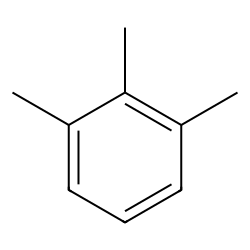
Cheméo RefData 1.0
One consistent value set for simulation, built from chemeo v31.
- Formula
- C9H12
- CAS
- 526-73-8
- Molecular Weight
- 120.19 g/mol
- SMILES
- Cc1cccc(C)c1C
- InChI Key
- FYGHSUNMUKGBRK-UHFFFAOYSA-N
Constants
| Property | Value | Unit | u95 | Basis | Sources |
|---|---|---|---|---|---|
| MW Molecular Weight |
120.19 | g/mol | derived | ||
| Tc Critical Temperature |
664.39 | K | 1.13 | experimental | KDB; NIST Webbook |
| Pc Critical Pressure |
3454.00 | kPa | 16.02 | experimental | KDB; NIST Webbook |
| Vc Critical Volume |
0.435 | m3/kmol | compiled Compiled value | ChemSep v8.3 pure component data | |
| Zc Critical Compressibility |
0.2719909 | derived | |||
| ω Acentric Factor |
0.3675 | derived | |||
| Tboil Normal Boiling Point Temperature |
449.24 | K | 0.39 | experimental | KDB; NIST Webbook |
| Tfus Normal melting (fusion) point |
247.74 | K | 0.25 | experimental | KDB; Aqueous Solubility Prediction Method; NIST Webbook |
| ΔfH°gas Enthalpy of formation at standard conditions |
-9.60 | kJ/mol | 3.38 | experimental | KDB; NIST Webbook |
| ΔfG° Standard Gibbs free energy of formation |
124.60 | kJ/mol | 4.00 | experimental | KDB |
Equations
| Property | Equation | Temperature (K) | Fit |
|---|---|---|---|
| Pvap Vapor pressure |
Y = exp(A + B/T + C·ln(T) + D·T^E) Y in kPa, T in K |
[247.79; 664.39] | compiled, 58 points, AARD 0.6% against its inputs, published equations only: agreement with those equations, not with measurements KDB Vapor Pressure Data; NIST Chemistry Webbook; The Yaws Handbook of Vapor Pressure |
| A = 5.03501e+01, B = -7.15927e+03, C = -4.88328e+00, D = 3.58851e-18, E = 6.00000e+00 | |||
| Cp,gas Ideal gas heat capacity |
Y = A + B·((C/T)/sinh(C/T))² + D·((E/T)/cosh(E/T))² Y in J/mol×K, T in K |
[200.00; 1500.00] | compiled, 20 points, AARD 0.1% against its inputs, published equations only: agreement with those equations, not with measurements ChemSep v8.3 pure component data |
| A = 1.05338e+02, B = 3.75524e+02, C = 1.43390e+03, D = 2.14275e+02, E = 6.62907e+02 | |||
| Cp,liquid Liquid phase heat capacity |
Y = A + B·T + C·T² + D·T³ + E·T⁴ Y in J/mol×K, T in K |
[250.00; 300.00] | experimental, 9 points, AARD 0.1% against the measurements |
| A = 1.34487e+02, B = 2.12574e-01, C = 2.02975e-04, D = 0.00000e+00, E = 0.00000e+00 | |||
| ΔvapH Enthalpy of vaporization at a given temperature |
Y = A·(1 − Tr)^(B + C·Tr + D·Tr² + E·Tr³), Tr = T/Tc Y in kJ/mol, T in K |
[247.79; 642.57] | derived, 30 points, AARD 0.3% against its inputs ChemSep v8.3 pure component data |
| A = 5.90101e+01, B = 3.60762e-01, C = -8.08564e-02, D = 7.79846e-02, E = 0.00000e+00, Tc = 6.64390e+02 K | |||
| ρl Liquid Density |
Y = A / B^(1 + (1 − T/C)^D) Y in kg/m3, T in K |
[265.31; 664.15] | compiled, 20 points, AARD 0.1% against its inputs, published equations only: agreement with those equations, not with measurements ChemSep v8.3 pure component data |
| A = 6.20550e+01, B = 2.39850e-01, C = 6.64390e+02, D = 2.40000e-01 | |||
| η Dynamic viscosity |
Y = exp(A + B/T + C·ln(T) + D·T^E) Y in Pa×s, T in K |
[247.79; 550.00] | compiled, 20 points, AARD 0.1% against its inputs, published equations only: agreement with those equations, not with measurements ChemSep v8.3 pure component data |
| A = -1.11502e+01, B = 1.45458e+03, C = -1.29649e-01, D = 0.00000e+00, E = 0.00000e+00 | |||
| λliquid Liquid thermal conductivity |
Y = A + B·T + C·T² + D·T³ + E·T⁴ Y in W/m×K, T in K |
[257.62; 331.17] | experimental, 18 points, AARD 0.1% against the measurements |
| A = 1.34082e-01, B = 1.87783e-04, C = -9.02914e-07, D = 6.74731e-10, E = 0.00000e+00 | |||
| λgas Gas thermal conductivity |
Y = A·T^B / (1 + C/T + D/T²) Y in W/m×K, T in K |
[247.79; 1000.00] | compiled, 20 points, AARD 1.0% against its inputs, published equations only: agreement with those equations, not with measurements ChemSep v8.3 pure component data |
| A = 2.45377e-05, B = 1.22338e+00, C = 4.41163e+02, D = 3.98428e+03 | |||
| γ Surface Tension |
Y = A·(1 − Tr)^(B + C·Tr + D·Tr² + E·Tr³), Tr = T/Tc Y in N/m, T in K |
[247.75; 642.57] | compiled, 41 points, AARD 4.7% against its inputs, published equations only: agreement with those equations, not with measurements Jasper (1972), surface tension of pure liquid compounds; ChemSep v8.3 pure component data |
| A = 9.50634e-02, B = 2.98350e+00, C = -2.58749e+00, D = 9.33909e-01, E = 0.00000e+00, Tc = 6.64390e+02 K | |||
Equation of state
| Model | Tc (K) | Pc (kPa) | ω | c1 | c2 | c3 | Volume shift (m³/kmol) | Pvap AARD |
|---|---|---|---|---|---|---|---|---|
| PR | 664.39 | 3454.00 | 0.3675 | 9.32902e-01 | -1.93630e-01 | 2.24238e-01 | 1.64432e-03 | 0.4% |
| SRK | 664.39 | 3454.00 | 0.3675 | 1.11026e+00 | -5.44488e-01 | 6.24847e-01 | 2.28274e-02 | 0.5% |
a(T) = Ωa·R²·Tc²/Pc·α(T) and b = Ωb·R·Tc/Pc, with Pc in Pa and R = 8.314462618 J/(mol·K); PR: Ωa = 0.45724, Ωb = 0.07780; SRK: Ωa = 0.42748, Ωb = 0.08664.
Mathias-Copeman alpha function, with Tr = T/Tc:
α(T) = [1 + c1·(1 − √Tr) + c2·(1 − √Tr)² + c3·(1 − √Tr)³]² for T ≤ Tc,
α(T) = [1 + c1·(1 − √Tr)]² above Tc.
Péneloux volume shift: v = vEOS − volume shift, fitted to the liquid density at 0.7·Tc (0 when there is no liquid density).
A binary interaction parameter is valid only with these parameters, from RefData 1.0.
Not in RefData for this compound
Rackett Parameter.
Checks
Deviation from the compiled data (ChemSep, ChEDL): Critical Temperature: 0.0%; Critical Pressure: 0.0%; Normal Boiling Point Temperature: 0.0%; Normal melting (fusion) point: 0.0%; Enthalpy of formation at standard conditions: 0.03 kJ/mol; Standard Gibbs free energy of formation: 0.20 kJ/mol; Vapor pressure: 3.4%; Liquid phase heat capacity: 0.3%; Liquid thermal conductivity: 2.6%.