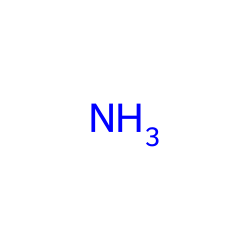
Cheméo RefData 1.0
One consistent value set for simulation, built from chemeo v31.
- Formula
- H3N
- CAS
- 7664-41-7
- Molecular Weight
- 17.03 g/mol
- SMILES
- N
- InChI Key
- QGZKDVFQNNGYKY-UHFFFAOYSA-N
Constants
| Property | Value | Unit | u95 | Basis | Sources |
|---|---|---|---|---|---|
| MW Molecular Weight |
17.03 | g/mol | derived | ||
| Tc Critical Temperature |
405.40 | K | 0.93 | experimental | Air Liquide Gas Encyclopedia; KDB; NIST Webbook; literature: 1 |
| Pc Critical Pressure |
11300.00 | kPa | 78.46 | experimental | Air Liquide Gas Encyclopedia; KDB; NIST Webbook |
| Vc Critical Volume |
0.072 | m3/kmol | 0.004 | experimental | KDB |
| Zc Critical Compressibility |
0.2413754 | derived | |||
| ω Acentric Factor |
0.2550 | derived | |||
| Tboil Normal Boiling Point Temperature |
239.82 | K | 1.44 | experimental | Air Liquide Gas Encyclopedia; KDB |
| Tfus Normal melting (fusion) point |
194.95 | K | 0.84 | experimental | Air Liquide Gas Encyclopedia; KDB; NIST Webbook |
| ΔfH°gas Enthalpy of formation at standard conditions |
-45.94 | kJ/mol | 1.07 | experimental | KDB; NIST Webbook |
| ΔfG° Standard Gibbs free energy of formation |
-16.16 | kJ/mol | 4.00 | experimental | KDB |
| Zra Rackett Parameter |
0.25 | 0.00 | experimental | KDB |
Equations
| Property | Equation | Temperature (K) | Fit |
|---|---|---|---|
| Pvap Vapor pressure |
Y = exp(A + B/T + C·ln(T) + D·T^E) Y in kPa, T in K |
[195.41; 405.40] | experimental, 88 points, AARD 0.7% against the measurements |
| A = 5.11954e+01, B = -3.99513e+03, C = -5.54005e+00, D = 7.66214e-06, E = 2.00000e+00 | |||
| Cp,gas Ideal gas heat capacity |
Y = A + B·((C/T)/sinh(C/T))² + D·((E/T)/cosh(E/T))² Y in J/mol×K, T in K |
[298.00; 6000.00] | compiled, 40 points, AARD 0.5% against its inputs, published equations only: agreement with those equations, not with measurements NIST Chemistry Webbook |
| A = 3.35810e+01, B = 4.98463e+01, C = 2.06639e+03, D = 2.25825e+01, E = -8.93891e+02 | |||
| Cp,liquid Liquid phase heat capacity |
Y = A + B·T + C·T² + D·T³ + E·T⁴ Y in J/mol×K, T in K |
[195.45; 390.32] | compiled, 19 points, AARD 5.6% against its inputs, published equations only: agreement with those equations, not with measurements ChemSep v8.3 pure component data |
| A = -7.28320e+02, B = 9.37180e+00, C = -3.57461e-02, D = 4.48339e-05, E = 0.00000e+00 | |||
| ΔvapH Enthalpy of vaporization at a given temperature |
Y = A·(1 − Tr)^(B + C·Tr + D·Tr² + E·Tr³), Tr = T/Tc Y in kJ/mol, T in K |
[195.41; 403.15] | derived, 31 points, AARD 0.7% against its inputs ChemSep v8.3 pure component data |
| A = 2.95738e+01, B = 3.29008e-01, C = -3.54999e-01, D = 4.00234e-01, E = 0.00000e+00, Tc = 4.05400e+02 K | |||
| ρl Liquid Density |
Y = A / B^(1 + (1 − T/C)^D) Y in kg/m3, T in K |
[195.00; 405.15] | compiled, 22 points, AARD 0.0% against its inputs, published equations only: agreement with those equations, not with measurements ChemSep v8.3 pure component data |
| A = 6.90491e+01, B = 2.71277e-01, C = 4.05400e+02, D = 3.14000e-01 | |||
| η Dynamic viscosity |
Y = exp(A + B/T + C·ln(T) + D·T^E) Y in Pa×s, T in K |
[195.41; 387.48] | compiled, 19 points, AARD 1.5% against its inputs, published equations only: agreement with those equations, not with measurements ChemSep v8.3 pure component data |
| A = 6.27705e+00, B = 1.26813e+02, C = -2.75024e+00, D = 0.00000e+00, E = 0.00000e+00 | |||
| λliquid Liquid thermal conductivity |
Y = A + B·T + C·T² + D·T³ + E·T⁴ Y in W/m×K, T in K |
[195.41; 400.05] | compiled, 20 points, AARD 0.0% against its inputs, published equations only: agreement with those equations, not with measurements ChemSep v8.3 pure component data |
| A = 1.18541e+00, B = -2.50758e-03, C = 6.97369e-07, D = -7.66874e-10, E = 0.00000e+00 | |||
| λgas Gas thermal conductivity |
Y = A·T^B / (1 + C/T + D/T²) Y in W/m×K, T in K |
[200.00; 900.00] | compiled, 20 points, AARD 0.2% against its inputs, published equations only: agreement with those equations, not with measurements ChemSep v8.3 pure component data |
| A = 9.65074e-06, B = 1.37989e+00, C = 0.00000e+00, D = 0.00000e+00 | |||
| γ Surface Tension |
Y = A·(1 − Tr)^(B + C·Tr + D·Tr² + E·Tr³), Tr = T/Tc Y in N/m, T in K |
[195.41; 403.30] | compiled, 20 points, AARD 8.3% against its inputs, published equations only: agreement with those equations, not with measurements ChemSep v8.3 pure component data |
| A = 6.49581e+00, B = 1.56399e+01, C = -2.08815e+01, D = 7.55372e+00, E = 0.00000e+00, Tc = 4.05400e+02 K | |||
Equation of state
| Model | Tc (K) | Pc (kPa) | ω | c1 | c2 | c3 | Volume shift (m³/kmol) | Pvap AARD |
|---|---|---|---|---|---|---|---|---|
| PR | 405.40 | 11300.00 | 0.2550 | 7.35797e-01 | 1.37996e-01 | -3.91055e-01 | 3.23512e-03 | 0.0% |
| SRK | 405.40 | 11300.00 | 0.2550 | 8.99601e-01 | -1.76806e-01 | -3.30430e-02 | 7.27300e-03 | 0.0% |
a(T) = Ωa·R²·Tc²/Pc·α(T) and b = Ωb·R·Tc/Pc, with Pc in Pa and R = 8.314462618 J/(mol·K); PR: Ωa = 0.45724, Ωb = 0.07780; SRK: Ωa = 0.42748, Ωb = 0.08664.
Mathias-Copeman alpha function, with Tr = T/Tc:
α(T) = [1 + c1·(1 − √Tr) + c2·(1 − √Tr)² + c3·(1 − √Tr)³]² for T ≤ Tc,
α(T) = [1 + c1·(1 − √Tr)]² above Tc.
Péneloux volume shift: v = vEOS − volume shift, fitted to the liquid density at 0.7·Tc (0 when there is no liquid density).
A binary interaction parameter is valid only with these parameters, from RefData 1.0.
Literature
- Critical parameters for ammonia
M. Sato, G. Masui, M. Uematsu
10.1016/j.jct.2004.12.016, Vol. 37 (2005)
Checks
Deviation from the compiled data (ChemSep, ChEDL): Critical Temperature: 0.0%; Critical Pressure: 0.5%; Critical Volume: 0.7%; Normal Boiling Point Temperature: 0.0%; Normal melting (fusion) point: 0.2%; Enthalpy of formation at standard conditions: 0.04 kJ/mol; Standard Gibbs free energy of formation: 0.24 kJ/mol; Rackett Parameter: 0.0%; Vapor pressure: 0.7%; Ideal gas heat capacity: 0.5%.