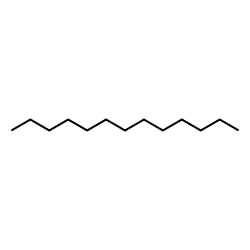
Cheméo RefData 1.0
One consistent value set for simulation, built from chemeo v31.
- Formula
- C13H28
- CAS
- 629-50-5
- Molecular Weight
- 184.36 g/mol
- SMILES
- CCCCCCCCCCCCC
- InChI Key
- IIYFAKIEWZDVMP-UHFFFAOYSA-N
Constants
| Property | Value | Unit | u95 | Basis | Sources |
|---|---|---|---|---|---|
| MW Molecular Weight |
184.36 | g/mol | derived | ||
| Tc Critical Temperature |
676.00 | K | 0.82 | experimental | KDB; NIST Webbook |
| Pc Critical Pressure |
1680.00 | kPa | 78.46 | experimental | KDB; NIST Webbook |
| Vc Critical Volume |
0.823 | m3/kmol | 0.049 | experimental | KDB; NIST Webbook |
| Zc Critical Compressibility |
0.2459961 | derived | |||
| ω Acentric Factor |
0.6044 | derived | |||
| Tboil Normal Boiling Point Temperature |
507.75 | K | 1.60 | experimental | KDB; NIST Webbook |
| Tfus Normal melting (fusion) point |
267.76 | K | 0.28 | experimental | KDB; NIST Webbook; literature: 1, 2 |
| ΔfH°gas Enthalpy of formation at standard conditions |
-311.50 | kJ/mol | 3.87 | experimental | KDB; NIST Webbook |
| ΔfG° Standard Gibbs free energy of formation |
58.49 | kJ/mol | 4.00 | experimental | KDB |
Equations
| Property | Equation | Temperature (K) | Fit |
|---|---|---|---|
| Pvap Vapor pressure |
Y = exp(A + B/T + C·ln(T) + D·T^E) Y in kPa, T in K |
[267.76; 676.00] | compiled, 57 points, AARD 1.2% against its inputs, published equations only: agreement with those equations, not with measurements KDB Vapor Pressure Data; NIST Chemistry Webbook; The Yaws Handbook of Vapor Pressure |
| A = 1.10016e+02, B = -1.10081e+04, C = -1.41453e+01, D = 8.68148e-03, E = 1.00000e+00 | |||
| Cp,gas Ideal gas heat capacity |
Y = A + B·((C/T)/sinh(C/T))² + D·((E/T)/cosh(E/T))² Y in J/mol×K, T in K |
[200.00; 1500.00] | compiled, 20 points, AARD 0.2% against its inputs, published equations only: agreement with those equations, not with measurements ChemSep v8.3 pure component data |
| A = 2.08859e+02, B = 7.18431e+02, C = 1.53387e+03, D = 4.48888e+02, E = 6.93152e+02 | |||
| Cp,liquid Liquid phase heat capacity |
Y = A + B·T + C·T² + D·T³ + E·T⁴ Y in J/mol×K, T in K |
[267.76; 508.62] | compiled, 22 points, AARD 0.0% against its inputs, published equations only: agreement with those equations, not with measurements ChemSep v8.3 pure component data |
| A = 4.47349e+02, B = -8.88023e-01, C = 3.05262e-03, D = -1.74607e-06, E = 0.00000e+00 | |||
| ΔvapH Enthalpy of vaporization at a given temperature |
Y = A·(1 − Tr)^(B + C·Tr + D·Tr² + E·Tr³), Tr = T/Tc Y in kJ/mol, T in K |
[308.00; 608.40] | experimental, 19 points, AARD 0.9% against the measurements |
| A = 1.46622e+02, B = 2.52928e+00, C = -3.25939e+00, D = 1.32635e+00, E = 0.00000e+00, Tc = 6.76000e+02 K | |||
| ρl Liquid Density |
Y = A / B^(1 + (1 − T/C)^D) Y in kg/m3, T in K |
[267.76; 675.00] | compiled, 26 points, AARD 0.4% against its inputs, published equations only: agreement with those equations, not with measurements ChemSep v8.3 pure component data |
| A = 1.54129e+01, B = 1.29831e-01, C = 6.76000e+02, D = 1.75000e-01 | |||
| η Dynamic viscosity |
Y = exp(A + B/T + C·ln(T) + D·T^E) Y in Pa×s, T in K |
[267.67; 675.00] | compiled, 24 points, AARD 5.7% against its inputs, published equations only: agreement with those equations, not with measurements ChemSep v8.3 pure component data |
| A = 6.84316e+00, B = 5.85391e+02, C = -2.66165e+00, D = 0.00000e+00, E = 0.00000e+00 | |||
| λliquid Liquid thermal conductivity |
Y = A + B·T + C·T² + D·T³ + E·T⁴ Y in W/m×K, T in K |
[267.76; 508.62] | compiled, 20 points, AARD 0.1% against its inputs, published equations only: agreement with those equations, not with measurements ChemSep v8.3 pure component data |
| A = 1.84122e-01, B = -7.11769e-06, C = -7.27716e-07, D = 7.73077e-10, E = 0.00000e+00 | |||
| λgas Gas thermal conductivity |
Y = A·T^B / (1 + C/T + D/T²) Y in W/m×K, T in K |
[267.76; 1000.00] | compiled, 20 points, AARD 1.6% against its inputs, published equations only: agreement with those equations, not with measurements ChemSep v8.3 pure component data |
| A = 8.74706e-08, B = 2.00748e+00, C = 0.00000e+00, D = 0.00000e+00 | |||
| γ Surface Tension |
Y = A·(1 − Tr)^(B + C·Tr + D·Tr² + E·Tr³), Tr = T/Tc Y in N/m, T in K |
[267.76; 647.01] | compiled, 43 points, AARD 2.5% against its inputs, published equations only: agreement with those equations, not with measurements Jasper (1972), surface tension of pure liquid compounds; ChemSep v8.3 pure component data |
| A = 4.89786e-02, B = 5.55004e-01, C = 1.75426e+00, D = -1.06938e+00, E = 0.00000e+00, Tc = 6.76000e+02 K | |||
Equation of state
| Model | Tc (K) | Pc (kPa) | ω | c1 | c2 | c3 | Volume shift (m³/kmol) | Pvap AARD |
|---|---|---|---|---|---|---|---|---|
| PR | 676.00 | 1680.00 | 0.6044 | 1.13236e+00 | 7.51197e-01 | -1.39731e+00 | 2.96918e-02 | 0.5% |
| SRK | 676.00 | 1680.00 | 0.6044 | 1.32776e+00 | 3.90476e-01 | -1.00137e+00 | 7.23867e-02 | 0.4% |
a(T) = Ωa·R²·Tc²/Pc·α(T) and b = Ωb·R·Tc/Pc, with Pc in Pa and R = 8.314462618 J/(mol·K); PR: Ωa = 0.45724, Ωb = 0.07780; SRK: Ωa = 0.42748, Ωb = 0.08664.
Mathias-Copeman alpha function, with Tr = T/Tc:
α(T) = [1 + c1·(1 − √Tr) + c2·(1 − √Tr)² + c3·(1 − √Tr)³]² for T ≤ Tc,
α(T) = [1 + c1·(1 − √Tr)]² above Tc.
Péneloux volume shift: v = vEOS − volume shift, fitted to the liquid density at 0.7·Tc (0 when there is no liquid density).
A binary interaction parameter is valid only with these parameters, from RefData 1.0.
Not in RefData for this compound
Rackett Parameter.
Literature
- Phase diagrams of binary systems containing n-alkanes, or cyclohexane, or 1-alkanols and 2,3-pentanedione at atmospheric and high pressure
U. Domanska, P. Morawski, R. Wierzbicki
10.1016/j.fluid.2006.02.001, Vol. 242 (2006) - Influence of High Pressure on the Liquidus Curve Shape in Binary Hydrocarbon Mixtures: Experimental Data, Correlation, and Prediction
U. Domanska, P. Morawski
10.1021/je050039p, Vol. 50 (2005)
Checks
Deviation from the compiled data (ChemSep, ChEDL): Critical Temperature: 0.1%; Critical Pressure: 0.0%; Critical Volume: 0.0%; Normal Boiling Point Temperature: 0.2%; Normal melting (fusion) point: 0.0%; Enthalpy of formation at standard conditions: 0.27 kJ/mol; Standard Gibbs free energy of formation: 0.78 kJ/mol; Vapor pressure: 3.0%; Enthalpy of vaporization at a given temperature: 1.1%.