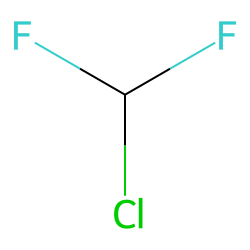
Cheméo RefData 1.0
One consistent value set for simulation, built from chemeo v31.
- Formula
- CHClF2
- CAS
- 75-45-6
- Molecular Weight
- 86.47 g/mol
- SMILES
- FC(F)Cl
- InChI Key
- VOPWNXZWBYDODV-UHFFFAOYSA-N
Constants
| Property | Value | Unit | u95 | Basis | Sources |
|---|---|---|---|---|---|
| MW Molecular Weight |
86.47 | g/mol | derived | ||
| Tc Critical Temperature |
369.30 | K | 0.31 | experimental | KDB; NIST Webbook |
| Pc Critical Pressure |
4987.10 | kPa | 21.77 | experimental | KDB; NIST Webbook |
| ω Acentric Factor |
0.2205 | derived | |||
| Tboil Normal Boiling Point Temperature |
232.37 | K | 0.80 | experimental | KDB; NIST Webbook; NCMS SOLV-DB |
| ΔfG° Standard Gibbs free energy of formation |
-470.90 | kJ/mol | 4.00 | experimental | KDB |
| Zra Rackett Parameter |
0.27 | 0.01 | experimental | KDB |
Equations
| Property | Equation | Temperature (K) | Fit |
|---|---|---|---|
| Pvap Vapor pressure |
Y = exp(A + B/T + C·ln(T) + D·T^E) Y in kPa, T in K |
[115.73; 369.30] | experimental, 109 points, AARD 0.7% against the measurements |
| A = 1.14129e+02, B = -5.03274e+03, C = -1.73390e+01, D = 2.84709e-02, E = 1.00000e+00 | |||
| Cp,gas Ideal gas heat capacity |
Y = A + B·((C/T)/sinh(C/T))² + D·((E/T)/cosh(E/T))² Y in J/mol×K, T in K |
[298.00; 6000.00] | compiled, 40 points, AARD 0.1% against its inputs, published equations only: agreement with those equations, not with measurements NIST Chemistry Webbook |
| A = 4.58742e+01, B = 6.21507e+01, C = 7.09104e+02, D = -1.32627e+01, E = -9.31888e+02 | |||
| Cp,liquid Liquid phase heat capacity |
Y = A + B·T + C·T² + D·T³ + E·T⁴ Y in J/mol×K, T in K |
[120.00; 330.00] | experimental, 25 points, AARD 0.2% against the measurements |
| A = 6.74375e+01, B = 4.90974e-01, C = -3.20860e-03, D = 6.82996e-06, E = 0.00000e+00 | |||
| ΔvapH Enthalpy of vaporization at a given temperature |
Y = A·(1 − Tr)^(B + C·Tr + D·Tr² + E·Tr³), Tr = T/Tc Y in kJ/mol, T in K |
[184.65; 332.37] | experimental, 14 points, AARD 0.4% against the measurements |
| A = 4.85135e+01, B = 2.12088e+00, C = -2.65043e+00, D = 1.06404e+00, E = 0.00000e+00, Tc = 3.69300e+02 K | |||
| ρl Liquid Density |
Y = A / B^(1 + (1 − T/C)^D) Y in kg/m3, T in K |
[237.03; 306.98] | experimental, 16 points, AARD 0.1% against the measurements |
| A = 1.63602e+02, B = 2.88801e-01, C = 3.69300e+02, D = 3.12000e-01 | |||
Equation of state
| Model | Tc (K) | Pc (kPa) | ω | c1 | c2 | c3 | Volume shift (m³/kmol) | Pvap AARD |
|---|---|---|---|---|---|---|---|---|
| PR | 369.30 | 4987.10 | 0.2205 | 7.17929e-01 | -2.66056e-01 | 9.62286e-01 | -1.49016e-03 | 0.1% |
| SRK | 369.30 | 4987.10 | 0.2205 | 8.77823e-01 | -5.73449e-01 | 1.32782e+00 | 6.90054e-03 | 0.2% |
a(T) = Ωa·R²·Tc²/Pc·α(T) and b = Ωb·R·Tc/Pc, with Pc in Pa and R = 8.314462618 J/(mol·K); PR: Ωa = 0.45724, Ωb = 0.07780; SRK: Ωa = 0.42748, Ωb = 0.08664.
Mathias-Copeman alpha function, with Tr = T/Tc:
α(T) = [1 + c1·(1 − √Tr) + c2·(1 − √Tr)² + c3·(1 − √Tr)³]² for T ≤ Tc,
α(T) = [1 + c1·(1 − √Tr)]² above Tc.
Péneloux volume shift: v = vEOS − volume shift, fitted to the liquid density at 0.7·Tc (0 when there is no liquid density).
A binary interaction parameter is valid only with these parameters, from RefData 1.0.
Not in RefData for this compound
Critical Volume, Critical Compressibility, Normal melting (fusion) point, Enthalpy of formation at standard conditions, Dynamic viscosity, Liquid thermal conductivity, Gas thermal conductivity, Surface Tension.
Checks
Deviation from the compiled data (ChemSep, ChEDL): Critical Temperature: 0.0%; Critical Pressure: 0.2%; Rackett Parameter: 0.0%.