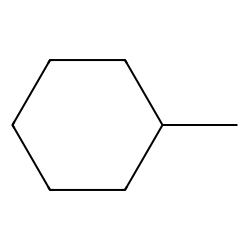
Cheméo RefData 1.0
One consistent value set for simulation, built from chemeo v31.
- Formula
- C7H14
- CAS
- 108-87-2
- Molecular Weight
- 98.19 g/mol
- SMILES
- CC1CCCCC1
- InChI Key
- UAEPNZWRGJTJPN-UHFFFAOYSA-N
Constants
| Property | Value | Unit | u95 | Basis | Sources |
|---|---|---|---|---|---|
| MW Molecular Weight |
98.19 | g/mol | derived | ||
| Tc Critical Temperature |
572.20 | K | 0.61 | experimental | KDB; NIST Webbook |
| Pc Critical Pressure |
3477.68 | kPa | 15.06 | experimental | KDB; NIST Webbook; literature: 1 |
| Vc Critical Volume |
0.369 | m3/kmol | 0.022 | experimental | KDB; NIST Webbook |
| Zc Critical Compressibility |
0.2697329 | derived | |||
| ω Acentric Factor |
0.2383 | derived | |||
| Tboil Normal Boiling Point Temperature |
374.05 | K | 0.65 | experimental | KDB; NIST Webbook; literature: 2, 3, 4, 5, 6, 7, 8, 9 |
| Tfus Normal melting (fusion) point |
146.67 | K | 0.51 | experimental | KDB; Aqueous Solubility Prediction Method; NIST Webbook |
| ΔfH°gas Enthalpy of formation at standard conditions |
-154.80 | kJ/mol | 2.77 | experimental | KDB; NIST Webbook |
| ΔfG° Standard Gibbs free energy of formation |
27.30 | kJ/mol | 4.00 | experimental | KDB |
| Zra Rackett Parameter |
0.27 | 0.01 | experimental | KDB |
Equations
| Property | Equation | Temperature (K) | Fit |
|---|---|---|---|
| Pvap Vapor pressure |
Y = exp(A + B/T + C·ln(T) + D·T^E) Y in kPa, T in K |
[146.58; 572.20] | experimental, 108 points, AARD 0.6% against the measurements |
| A = 8.80575e+01, B = -7.14984e+03, C = -1.10614e+01, D = 8.63303e-06, E = 2.00000e+00 | |||
| Cp,gas Ideal gas heat capacity |
Y = A + B·((C/T)/sinh(C/T))² + D·((E/T)/cosh(E/T))² Y in J/mol×K, T in K |
[200.00; 1500.00] | compiled, 26 points, AARD 0.2% against its inputs, published equations only: agreement with those equations, not with measurements ChemSep v8.3 pure component data |
| A = 8.80856e+01, B = 4.07404e+02, C = 1.49684e+03, D = 2.53051e+02, E = 7.22691e+02 | |||
| Cp,liquid Liquid phase heat capacity |
Y = A + B·T + C·T² + D·T³ + E·T⁴ Y in J/mol×K, T in K |
[150.00; 310.00] | experimental, 27 points, AARD 0.1% against the measurements |
| A = 1.30248e+02, B = -5.40999e-02, C = 7.91454e-04, D = 1.27861e-08, E = 0.00000e+00 | |||
| ΔvapH Enthalpy of vaporization at a given temperature |
Y = A·(1 − Tr)^(B + C·Tr + D·Tr² + E·Tr³), Tr = T/Tc Y in kJ/mol, T in K |
[286.10; 514.98] | experimental, 19 points, AARD 0.6% against the measurements |
| A = 5.08828e+01, B = 6.39875e-01, C = -3.30689e-01, D = 8.82317e-02, E = 0.00000e+00, Tc = 5.72200e+02 K | |||
| ρl Liquid Density |
Y = A / B^(1 + (1 − T/C)^D) Y in kg/m3, T in K |
[146.58; 572.10] | compiled, 162 points, AARD 0.1% against its inputs, published equations only: agreement with those equations, not with measurements ChemSep v8.3 pure component data |
| A = 5.25897e+01, B = 2.32248e-01, C = 5.72200e+02, D = 2.46000e-01 | |||
| λliquid Liquid thermal conductivity |
Y = A + B·T + C·T² + D·T³ + E·T⁴ Y in W/m×K, T in K |
[273.15; 374.08] | compiled, 20 points, AARD 0.0% against its inputs, published equations only: agreement with those equations, not with measurements ChemSep v8.3 pure component data |
| A = 8.80404e-02, B = 6.08644e-04, C = -2.55516e-06, D = 2.58398e-09, E = 0.00000e+00 | |||
| λgas Gas thermal conductivity |
Y = A·T^B / (1 + C/T + D/T²) Y in W/m×K, T in K |
[146.58; 1000.00] | compiled, 20 points, AARD 0.1% against its inputs, published equations only: agreement with those equations, not with measurements ChemSep v8.3 pure component data |
| A = 2.62406e-05, B = 1.24804e+00, C = 3.84736e+02, D = 1.18919e+04 | |||
Equation of state
| Model | Tc (K) | Pc (kPa) | ω | c1 | c2 | c3 | Volume shift (m³/kmol) | Pvap AARD |
|---|---|---|---|---|---|---|---|---|
| PR | 572.20 | 3477.68 | 0.2383 | 7.79592e-01 | -5.58932e-01 | 1.44082e+00 | -5.68944e-03 | 0.3% |
| SRK | 572.20 | 3477.68 | 0.2383 | 9.43750e-01 | -8.89353e-01 | 1.84405e+00 | 1.28816e-02 | 0.3% |
a(T) = Ωa·R²·Tc²/Pc·α(T) and b = Ωb·R·Tc/Pc, with Pc in Pa and R = 8.314462618 J/(mol·K); PR: Ωa = 0.45724, Ωb = 0.07780; SRK: Ωa = 0.42748, Ωb = 0.08664.
Mathias-Copeman alpha function, with Tr = T/Tc:
α(T) = [1 + c1·(1 − √Tr) + c2·(1 − √Tr)² + c3·(1 − √Tr)³]² for T ≤ Tc,
α(T) = [1 + c1·(1 − √Tr)]² above Tc.
Péneloux volume shift: v = vEOS − volume shift, fitted to the liquid density at 0.7·Tc (0 when there is no liquid density).
A binary interaction parameter is valid only with these parameters, from RefData 1.0.
Binary interaction parameters
| Partner | Model | kij | Grade | Fit | Mixture data |
|---|---|---|---|---|---|
| Ethanol | PR | 0.0874 | B | 22 points from 1 dataset, 345.30 to 368.84 K, at 101.3 kPa; AARD 8.9%, 27.3% at kij = 0; a constant kij describes this system poorly, prefer an activity model | 13-463-d |
| Ethanol | SRK | 0.0917 | B | 22 points from 1 dataset, 345.30 to 368.84 K, at 101.3 kPa; AARD 8.9%, 27.6% at kij = 0; a constant kij describes this system poorly, prefer an activity model | 13-463-d |
| Heptane | PR | -0.0045 | A | 95 points from 1 dataset, 342.81 to 371.04 K, 40.0 to 93.3 kPa; AARD 0.1%, 1.1% at kij = 0 | 14-513-g |
| Heptane | SRK | -0.0043 | A | 95 points from 1 dataset, 342.81 to 371.04 K, 40.0 to 93.3 kPa; AARD 0.2%, 1.0% at kij = 0 | 14-513-g |
| p-Xylene | PR | 0.0148 | A | 18 points from 1 dataset, 374.38 to 407.55 K, at 101.3 kPa; AARD 0.4%, 3.4% at kij = 0 | 13-770-c |
| p-Xylene | SRK | 0.0153 | A | 18 points from 1 dataset, 374.38 to 407.55 K, at 101.3 kPa; AARD 0.4%, 3.5% at kij = 0 | 13-770-c |
| Toluene | PR | 0.0088 | A | 15 points from 1 dataset, 303.15 to 373.15 K, 5.8 to 79.2 kPa; AARD 2.0%, 3.2% at kij = 0 | 12-616-e |
| Toluene | SRK | 0.0088 | A | 15 points from 1 dataset, 303.15 to 373.15 K, 5.8 to 79.2 kPa; AARD 1.9%, 3.1% at kij = 0 | 12-616-e |
Grade A: the kij reproduces the measured pressures within 5% on average (AARD), B within 15%. A grade says how well one constant kij reproduces the measured points in its temperature and pressure range, nothing more: a pair that splits into two liquids is not described by it.
Not in RefData for this compound
Dynamic viscosity, Surface Tension.
Literature
- Critical Point Measurements for Five n-Alkylcyclohexanes (C6 to C10) by the Pulse-Heating Method
E. D. Nikitin, A. P. Popov, N. S. Bogatishcheva
10.1021/je0256535, Vol. 48 (2003) - Isobaric vapor liquid equilibrium for ternary mixtures of ethanol and methylcyclohexane with 3-methylpentane and tert-butyl alcohol at 101.3 kPa
M. d. C. Sanchez-Russinyol, A. Aucejo, S. Loras
10.1016/j.fluid.2007.06.008, Vol. 261 (2007) - Measurement on vapor pressure, density and viscosity for binary mixtures of JP-10 and methylcyclohexane
Y. Xing, X. Yang, W. Fang, Y. Guo, R. Lin
10.1016/j.fluid.2011.03.030, Vol. 305 (2011) - Isobaric vapor-liquid equilibrium data for methylcyclohexane + 2-methoxyethanol and methylcyclohexane + 2-ethoxyethanol at 50.00 and 101.33 kPa
L. Wang, P. Bai
10.1016/j.fluid.2014.07.041, Vol. 380 (2014) - VLE of the binary systems (dimethyl carbonate with 2-propanol or 2-butanol) and (diethyl carbonate with methylcyclohexane) at 101.3 kPa
A. B. Pereiro, A. Rodriguez, J. Canosa, J. Tojo
10.1016/j.jct.2004.09.009, Vol. 37 (2005) - Excess molar volumes of the ternary system {methylcyclohexane (1) + cyclohexane (2) + n-alkanes (3)} at T = 298.15 K
H. Iloukhani, M. Rezaei-Sameti
10.1016/j.jct.2005.02.006, Vol. 37 (2005) - Isobaric Vapor-Liquid Equilibrium for Two Binary Systems of n-Heptane + sec-Butyl Acetate and Methylcyclohexane + sec-Butyl Acetate under Atmosphere
Lixin Liu, Dianliang Fu, Yinhai Sun, Shoutao Ma, Lanyi Sun
10.1021/acs.jced.7b00999, Vol. 63 (2018) - Isobaric Vapor-Liquid Equilibrium for Two Binary Systems of 3,3-Dimethyloxetane + Methyl Cyclohexane and 3-Chloro-2,2-dimethyl-1-propanol + Methyl Cyclohexane at 101.3 kPa
Daixiang Wei, Lingqi Kong, Xinshun Tan, Shiqing Zheng
10.1021/acs.jced.8b00966, Vol. 64 (2019) - Isobaric Vapor-Liquid Equilibria for Binary and Ternary Mixtures of Ethanol, Methylcyclohexane and p-Xylene
M. d. C. Sanchez-Russinyol, A. Aucejo, S. Loras
10.1021/je0342318, Vol. 49 (2004)
Checks
Deviation from the compiled data (ChemSep, ChEDL): Critical Temperature: 0.0%; Critical Pressure: 0.2%; Critical Volume: 0.3%; Normal Boiling Point Temperature: 0.0%; Normal melting (fusion) point: 0.1%; Enthalpy of formation at standard conditions: 0.00 kJ/mol; Standard Gibbs free energy of formation: 0.03 kJ/mol; Rackett Parameter: 0.2%; Vapor pressure: 1.3%; Liquid phase heat capacity: 0.1%; Enthalpy of vaporization at a given temperature: 1.3%.