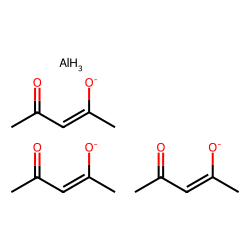
- InChI
- InChI=1S/3C5H8O2.Al/c3*1-4(6)3-5(2)7;/h3*3,6H,1-2H3;/q;;;+3/p-3/b3*4-3-;
- InChI Key
- KILURZWTCGSYRE-LNTINUHCSA-K
- Formula
- C15H21AlO6
- SMILES
-
CC(=O)/C=C(/C)[O-].CC(=O)/C=C(
/C)[O-].CC(=O)/C=C(/C)[O-].[Al +3] - Molecular Weight1
- 324.31
- CAS
- 13963-57-0
- Other Names
-
- Aluminum 2,4-pentanedionate
- Aluminum Chelate A
- Aluminum acetylacetonate
- Aluminum triacetylacetonate
- Aluminum(III) acetylacetonate
- Aluminum, tris(2,4-pentanedionato)-
- Aluminum, tris(2,4-pentanedionato-O,O')-, (OC-6-11)-
- Aluminum, tris(2,4-pentanedionato-«kappa»O,«kappa»O')-, (OC-6-11)-
- Aluminum, tris(2,4-pentanedionato-«kappa»O2,«kappa»O4)-, (OC-6-11)-
- NSC 4650
- Tris(2,4-pentanedionato)aluminum
- Tris(2,4-pentanedione)aluminum
- Tris(acetylacetonato) aluminium
- Tris(acetylacetonato) aluminium(III)
- Tris(acetylacetonato)aluminum
- Tris(acetylacetone)aluminum
- Tris(acetylacetonyl)aluminum
- aluminium tris(2,4-pentanedionato-O,O')
- tris(pentane-2,4-dionato)aluminum
- Cp,solid : Solid phase heat capacity (J/mol×K).
- ΔfH°gas : Enthalpy of formation at standard conditions (kJ/mol).
- ΔfH°solid : Solid phase enthalpy of formation at standard conditions (kJ/mol).
- ΔfusH : Enthalpy of fusion at a given temperature (kJ/mol).
- ΔsubH° : Enthalpy of sublimation at standard conditions (kJ/mol).
- ΔsubH : Enthalpy of sublimation at a given temperature (kJ/mol).
- ΔvapH° : Enthalpy of vaporization at standard conditions (kJ/mol).
- ΔvapH : Enthalpy of vaporization at a given temperature (kJ/mol).
- IE : Ionization energy (eV).
- Pc : Critical Pressure (kPa).
- Psub : Sublimation pressure (kPa).
- ΔfusS : Entropy of fusion at a given temperature (J/mol×K).
- S°solid,1 bar : Solid phase molar entropy at standard conditions (J/mol×K).
- Tboil : Normal Boiling Point Temperature (K).
- Tc : Critical Temperature (K).
- Tfus : Normal melting (fusion) point (K).
- 1: Molecular weight from the IUPAC atomic weights tables.
Physical Properties
| Property | Value | Unit | Source |
|---|---|---|---|
| ΔfH°gas | -1671.20 ± 4.60 | kJ/mol | NIST Martinho Simões |
| Selected data. The enthalpy of formation is the average of the results obtained by CC-SB Cavell and Pilcher, 1977 and RSC Hill and Irving, 1966. | |||
| ΔfH°solid | -1792.90 ± 1.90 | kJ/mol | NIST Martinho Simões |
| Selected data. The enthalpy of formation is the average of the results obtained by CC-SB Cavell and Pilcher, 1977 and RSC Hill and Irving, 1966. | |||
| ΔsubH° | [120.00; 121.80] | kJ/mol |

|
| ΔsubH° | 121.80 ± 1.50 | kJ/mol | NISTSemyannikov, Igumenov, et al., 2006 |
| ΔsubH° | 120.00 ± 3.00 | kJ/mol | NIST Naghibi-Bidokhti, 1977 |
| See also da Silva and Ferrao, 1988. | |||
| ΔsubH° | 121.70 ± 4.20 | kJ/mol | NISTIrving and Ribeiro da Silva, 1975 |
| ΔsubH° | 121.70 ± 4.20 | kJ/mol | NISTIrving and da Silva, 1975 |
| ΔvapH° | 78.70 ± 0.90 | kJ/mol | NISTGrinberg, Lazarev, et al., 1986, 2 |
| IE | [7.50; 8.27] | eV |
|
| IE | 7.50 | eV | NISTAkopyan, Vovna, et al., 1990 |
| IE | 7.78 ± 0.05 | eV | NISTWestmore, Reimer, et al., 1981 |
| IE | 8.27 ± 0.13 | eV | NISTSchildcrout, Pearson, et al., 1968 |
| IE | 7.95 ± 0.05 | eV | NISTBancroft, Reichert, et al., 1968 |
| IE | 8.18 | eV | NIST Akopyan, Vovna, et al., 1990 |
| Vertical value | |||
| Pc | 1465.92 | kPa | Relay (1.0-beta) Calculated Property |
| S°solid,1 bar | 479.10 | J/mol×K | NISTTeghil, Ferro, et al., 1981 |
| Tboil | 667.95 | K | Relay (1.0) Calculated Property |
| Tc | 936.62 | K | Relay (1.0) Calculated Property |
| Tfus | [466.70; 467.70] | K |
|
| Tfus | 466.70 ± 0.20 | K | NISTGrinberg, Lazarev, et al., 1986 |
| Tfus | 467.70 ± 0.50 | K | NISTMurray and Hill, 1983 |

Cheméo can also estimate Critical Volume, Standard Gibbs free energy of formation, Acentric Factor, Log10 of Water solubility in mol/l for this compound, but they fall outside the models' validated range, so they are not shown here. Open the prediction tool to compute them on demand.
Temperature Dependent Properties
Similar Compounds


Find more compounds similar to Aluminum tris(acetylacetonate).
Mixtures
Sources
- Cheméo Relay (1.0)
- Cheméo Relay (1.0, beta) Beta: served but experimental, data-limited and below our cross-validation release bar; the Joback value is recommended where available.
- Determination and correlation of infinite dilution binary diffusion coefficients for aluminum acetylacetonate in supercritical and liquid fluids
- Thermodynamics of sublimation of aluminium triacetylacetonate
- Determination of the enthalpies of sublimation and evaporation from thermogravimetric data: Application to metalorganic complexes of Al and Cr
- NIST Webbook
Note: Cheméo is only indexing the data, follow the source links to retrieve the latest data. The source is also providing more information like the publication year, authors and more.
Take the time to validate and double check the source of the data.
Calculated This icon marks a calculated value or equation: a prediction, not a measurement.
These property values are available through the Cheméo API. A free account gives you an access key.