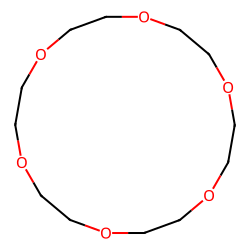
- InChI
- InChI=1S/C12H24O6/c1-2-14-5-6-16-9-10-18-12-11-17-8-7-15-4-3-13-1/h1-12H2
- InChI Key
- XEZNGIUYQVAUSS-UHFFFAOYSA-N
- Formula
- C12H24O6
- SMILES
- C1COCCOCCOCCOCCOCCO1
- Molecular Weight1
- 264.32
- CAS
- 17455-13-9
- Other Names
-
- 18-crown-6
- 18-crown-6 ether
- 18-crown-6- ether
- Crown ether 18-crown-6
- ethylene oxide cyclic hexamer
- ω : Acentric Factor.
- PAff : Proton affinity (kJ/mol).
- BasG : Gas basicity (kJ/mol).
- ΔcH°liquid : Standard liquid enthalpy of combustion (kJ/mol).
- ΔcH°solid : Standard solid enthalpy of combustion (kJ/mol).
- Cp,gas : Ideal gas heat capacity (J/mol×K).
- η : Dynamic viscosity (Pa×s).
- ΔfG° : Standard Gibbs free energy of formation (kJ/mol).
- ΔfH°gas : Enthalpy of formation at standard conditions (kJ/mol).
- ΔfH°solid : Solid phase enthalpy of formation at standard conditions (kJ/mol).
- ΔfusH° : Enthalpy of fusion at standard conditions (kJ/mol).
- ΔfusH : Enthalpy of fusion at a given temperature (kJ/mol).
- ΔsubH° : Enthalpy of sublimation at standard conditions (kJ/mol).
- ΔvapH° : Enthalpy of vaporization at standard conditions (kJ/mol).
- IE : Ionization energy (eV).
- log10WS : Log10 of Water solubility in mol/l.
- logPoct/wat : Octanol/Water partition coefficient.
- McVol : McGowan's characteristic volume (ml/mol).
- Pc : Critical Pressure (kPa).
- I : Polar retention indices.
- Tboil : Normal Boiling Point Temperature (K).
- Tboilr : Boiling point at reduced pressure (K).
- Tc : Critical Temperature (K).
- Tfus : Normal melting (fusion) point (K).
- Tfus : Melting point (K).
- Vc : Critical Volume (m3/kmol).
- 1: Molecular weight from the IUPAC atomic weights tables.
Cheméo is a service of Céondo GmbH, since 2007, we provide simulation, modelling and software development services for the industry.
Do not hesitate to contact us for your projects.
Physical Properties
| Property | Value | Unit | Source |
|---|---|---|---|
| ω | 0.4462 | Relay (1.0) Calculated Property | |
| PAff | 967.00 | kJ/mol | NIST |
| BasG | 909.50 | kJ/mol | NIST |
| ΔcH°liquid | -7061.80 ± 7.50 | kJ/mol | NIST |
| ΔcH°solid | -7071.00 ± 4.90 | kJ/mol | NIST |
| ΔfG° | -579.60 | kJ/mol | Joback Calculated Property |
| ΔfH°gas | -980.54 | kJ/mol | Relay (1.0) Calculated Property |
| ΔfH°solid | -1081.10 ± 2.80 | kJ/mol | NIST |
| ΔfusH° | 35.50 | kJ/mol | The Water 18-Crown-6 System: Experimental Investigation and Thermodynamic Modeling |
| ΔsubH° | 119.10 ± 6.70 | kJ/mol | NIST |
| ΔvapH° | 86.10 ± 6.70 | kJ/mol | NIST |
| IE | [8.90; 9.70] | eV |

|
| IE | 8.90 | eV | NIST |
| IE | 9.70 | eV | NIST |
| IE | 9.70 | eV | NIST |
| log10WS | -0.13 | Relay (1.0) Calculated Property | |
| logPoct/wat | 0.100 | Crippen Calculated Property | |
| McVol | 204.300 | ml/mol | McGowan Calculated Property |
| Pc | 2811.36 | kPa | Joback Calculated Property |
| I | [2504.00; 2504.00] |
|
|
| I | 2504.00 | NIST | |
| I | 2504.00 | NIST | |
| Tboil | 637.57 | K | Relay (1.0) Calculated Property |
| Tc | 815.45 | K | Relay (1.0) Calculated Property |
| Tfus | [310.00; 316.50] | K |
|
| Tfus | 312.25 | K | Structure and properties of congruent melting 18-crown-6 crystalline hydrates |
| Tfus | 312.32 | K | Enthalpies of fusion, vaporisation and sublimation of crown ethers determined by thermogravimetry and differential scanning calorimetry |
| Tfus | 316.50 | K | Static Dielectric Permittivity of Homologous Series of Liquid Cyclic Ethers, 3n-Crown-n, n = 4 to 6 |
| Tfus | 310.00 ± 1.00 | K | NIST |
| Vc | 0.695 | m3/kmol | Relay (1.0) Calculated Property |

Temperature Dependent Properties
| Property | Value | Unit | Temperature (K) | Source |
|---|---|---|---|---|
| ΔfusH | 34.00 | kJ/mol | 312.20 | NIST |
Pressure Dependent Properties
| Property | Value | Unit | Pressure (kPa) | Source |
|---|---|---|---|---|
| Tboilr | 391.50 ± 0.50 | K | 0.01 | NIST |
| Tfus | 311.76 | K | 101.30 | (Solid + liquid) phase equilibria of binary mixtures containing N-methyl-2-pyrrolidinone and ethers at atmospheric pressure |
Correlations
| Property | Value | Unit | Temperature (K) | Source |
|---|---|---|---|---|
| Cp,gas | [265.12; 755.31] | J/mol×K | [273.00; 1000.00] |
Joback Predicted correlation
|
| Equation | Y = A + B·T + C·T² + D·T³ + E·T⁴ Y is Cp,gas in J/mol×K, T in K | |||
| Coefficient A | -3.70900e+01 | |||
| Coefficient B | 1.15920e+00 | |||
| Coefficient C | -1.25200e-04 | |||
| Coefficient D | -2.41600e-07 | |||
| Coefficient E | 0.00000e+00 | |||
| Temperature range, min. | 273.00 | |||
| Temperature range, max. | 1000.00 | |||
| Cp,gas | 265.12 | J/mol×K | 273.00 | Calculated Property |
| Cp,gas | 346.64 | J/mol×K | 353.78 | Calculated Property |
| Cp,gas | 423.18 | J/mol×K | 434.56 | Calculated Property |
| Cp,gas | 493.97 | J/mol×K | 515.33 | Calculated Property |
| Cp,gas | 558.25 | J/mol×K | 596.11 | Calculated Property |
| Cp,gas | 615.27 | J/mol×K | 676.89 | Calculated Property |
| Cp,gas | 664.24 | J/mol×K | 757.67 | Calculated Property |
| Cp,gas | 704.42 | J/mol×K | 838.44 | Calculated Property |
| Cp,gas | 735.03 | J/mol×K | 919.22 | Calculated Property |
| Cp,gas | 755.31 | J/mol×K | 1000.00 | Calculated Property |
| Property | Value | Unit | Temperature (K) | Source |
|---|---|---|---|---|
| η | [0.0753355; 0.0000035] | Pa×s | [312.77; 687.20] |
Joback Predicted correlation
|
| Equation | Y = exp(A + B/T + C·ln(T) + D·T^E) Y is η in Pa×s, T in K | |||
| Coefficient A | -2.09188e+01 | |||
| Coefficient B | 5.73398e+03 | |||
| Coefficient C | 0.00000e+00 | |||
| Coefficient D | 0.00000e+00 | |||
| Coefficient E | 0.00000e+00 | |||
| Temperature range, min. | 312.77 | |||
| Temperature range, max. | 687.20 | |||
| η | 0.0753355 | Pa×s | 312.77 | Calculated Property |
| η | 0.0087552 | Pa×s | 354.37 | Calculated Property |
| η | 0.0015994 | Pa×s | 395.97 | Calculated Property |
| η | 0.0004037 | Pa×s | 437.58 | Calculated Property |
| η | 0.0001294 | Pa×s | 479.18 | Calculated Property |
| η | 0.0000497 | Pa×s | 520.78 | Calculated Property |
| η | 0.0000220 | Pa×s | 562.39 | Calculated Property |
| η | 0.0000109 | Pa×s | 603.99 | Calculated Property |
| η | 0.0000059 | Pa×s | 645.59 | Calculated Property |
| η | 0.0000035 | Pa×s | 687.20 | Calculated Property |
Similar Compounds


Find more compounds similar to 1,4,7,10,13,16-Hexaoxacyclooctadecane.
Mixtures
- Rubidium chloride + Water + 1,4,7,10,13,16-Hexaoxacyclooctadecane
- caesium chloride + Water + 1,4,7,10,13,16-Hexaoxacyclooctadecane
- sodium chloride + Water + 1,4,7,10,13,16-Hexaoxacyclooctadecane
- 2-Pyrrolidinone, 1-methyl- + 1,4,7,10,13,16-Hexaoxacyclooctadecane
- Water + 1,4,7,10,13,16-Hexaoxacyclooctadecane
- potassium chloride + Water + 1,4,7,10,13,16-Hexaoxacyclooctadecane
- Carbon Tetrachloride + 1,4,7,10,13,16-Hexaoxacyclooctadecane
- Glucose + Water + 1,4,7,10,13,16-Hexaoxacyclooctadecane
- Galactose + Water + 1,4,7,10,13,16-Hexaoxacyclooctadecane
- Fructose + Water + 1,4,7,10,13,16-Hexaoxacyclooctadecane
- Water + 1,4,7,10,13,16-Hexaoxacyclooctadecane + L-Arabinose
- lithium bromide + Water + 1,4,7,10,13,16-Hexaoxacyclooctadecane
- Hydroquinone + Water + 1,4,7,10,13,16-Hexaoxacyclooctadecane
Sources
- Cheméo Relay (1.0)
- Crippen Method
- Crippen Method
- (Solid + liquid) phase equilibria of binary mixtures containing N-methyl-2-pyrrolidinone and ethers at atmospheric pressure
- The experimental study on the influence of crown ethers and glycols on the mutual solubility of lithium bromide in water
- Thermodynamics of complexation of aqueous 18-crown-6 with potassium ion: apparent molar volumes and apparent molar heat capacities of aqueous 18-crown-6 and of the (18-crown-6 + potassium chloride) complex at temperatures (278.15 to 393.15) K, at molalities (0.02 to 0.3) mol.kg-1, and at the pressure 0.35 MPa
- Thermodynamics of complexation of aqueous 18-crown-6 with barium ion: apparent molar volumes and apparent molar heat capacities of aqueous (18-crown-6 + barium nitrate) at temperatures (278.15 to 393.15) K, at molalities (0.02 to 0.33) mol.kg-1, and at the pressure 0.35 MPa
- Thermodynamics of complexation of aqueous 18-crown-6 with sodium ion: apparent molar volumes and apparent molar heat capacities of aqueous (18-crown-6 + sodium chloride) at temperatures (278.15 to 393.15) K, at molalities (0.02 to 0.30) mol*kg-1, and at the pressure 0.35 MPa.
- Compressibility studies of aqueous and CCl4 solutions of 18-crown-6 at T = 298.15 K
- Thermodynamics of complexation of aqueous 18-crown-6 with rubidium and cesium ions: Apparent molar volumes and apparent molar heat capacities of aqueous (18-crown-6 + rubidium chloride) and (18-crown-6 + cesium chloride) at temperatures (278.15 to 393.15) K, at molalities (0.02 to 0.33) mol.kg-1, and at the pressure 0.35 MPa
- Thermochemical behaviour of crown ethers in the mixtures of water with organic solvents. Part IX. Effect of base acid properties of {(1 x)AN + xH2O} on the solution enthalpy of cyclic ethers in this mixed solvent at T = 298.15 K
- Partial molar volumes of organic solutes in water. XXVI. 15-Crown-5 and 18-crown-6 ethers at temperatures (298 to 573) K and pressures up to 30 MPa
- Selective interactions of 18-crown-6 with d-glucose and d-galactose in aqueous solutions: Titration calorimetry, densimetry, viscosimetry
- Thermochemical behavior of 18-crown-6 in aqueous solutions of some monosaccharides
- Structure and properties of congruent melting 18-crown-6 crystalline hydrates
- Use of quantitative structure property relationships to study the solvation process of 18-crown-6
- Enthalpies of fusion, vaporisation and sublimation of crown ethers determined by thermogravimetry and differential scanning calorimetry
- Viscosity Behavior of 18-Crown-6 in Aqueous and Carbon Tetrachloride Solutions at Different Temperatures and at Ambient Pressure
- Effect of Temperature on the Process of Hydrophobic Hydration. Part II. Hydrophobic Hydration of 15-Crown-5 and 18-Crown-6 Ethers
- Effect of Base Acid Properties of the Mixture of Water with Propan-1-ol on the Solution Enthalpy of Cyclic Ethers in This Mixture at T = 298.15 K
- Static Dielectric Permittivity of Homologous Series of Liquid Cyclic Ethers, 3n-Crown-n, n = 4 to 6
- The Water 18-Crown-6 System: Experimental Investigation and Thermodynamic Modeling
- Partial Molar Volumes and Partial Molar Isentropic Compressions of 15-Crown-5 and 18-Crown-6 Ethers at Infinite Dilution in Water at Temperatures T = (278 to 343) K and Atmospheric Pressure
- Activity Coefficient Studies in Ternary Aqueous Solutions at 298.15 K: H2O + r-Cyclodextrin + Potassium Acetate and H2O + 18-Crown-6 + Hydroquinone Systems
- Joback Method
- McGowan Method
- NIST Webbook
Note: Cheméo is only indexing the data, follow the source links to retrieve the latest data. The source is also providing more information like the publication year, authors and more.
Take the time to validate and double check the source of the data.
These property values are available through the Cheméo API. A free account gives you an access key.