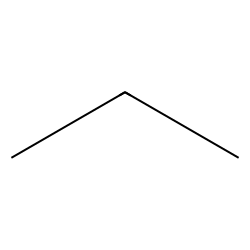
Cheméo RefData 1.0
One consistent value set for simulation, built from chemeo v31.
- Formula
- C3H8
- CAS
- 74-98-6
- Molecular Weight
- 44.10 g/mol
- SMILES
- CCC
- InChI Key
- ATUOYWHBWRKTHZ-UHFFFAOYSA-N
Constants
| Property | Value | Unit | u95 | Basis | Sources |
|---|---|---|---|---|---|
| MW Molecular Weight |
44.10 | g/mol | derived | ||
| Tc Critical Temperature |
369.85 | K | 0.35 | experimental | Air Liquide Gas Encyclopedia; KDB; NIST Webbook; literature: 1, 2, 3 |
| Pc Critical Pressure |
4253.70 | kPa | 22.16 | experimental | Air Liquide Gas Encyclopedia; KDB; NIST Webbook; literature: 1, 2, 3 |
| Vc Critical Volume |
0.200 | m3/kmol | 0.006 | experimental | KDB; NIST Webbook |
| Zc Critical Compressibility |
0.2766541 | derived | |||
| ω Acentric Factor |
0.1529 | derived | |||
| Tboil Normal Boiling Point Temperature |
231.04 | K | 0.18 | experimental | Air Liquide Gas Encyclopedia; KDB; NIST Webbook |
| ΔfH°gas Enthalpy of formation at standard conditions |
-104.70 | kJ/mol | 1.16 | experimental | KDB; NIST Webbook |
| ΔfG° Standard Gibbs free energy of formation |
-23.49 | kJ/mol | 4.00 | experimental | KDB |
| Zra Rackett Parameter |
0.28 | 0.01 | experimental | KDB |
Equations
| Property | Equation | Temperature (K) | Fit |
|---|---|---|---|
| Pvap Vapor pressure |
Y = exp(A + B/T + C·ln(T) + D·T^E) Y in kPa, T in K |
[127.00; 369.85] | experimental, 544 points, AARD 0.3% against the measurements |
| A = 5.38571e+01, B = -3.52862e+03, C = -6.35795e+00, D = 1.19481e-05, E = 2.00000e+00 | |||
| Cp,gas Ideal gas heat capacity |
Y = A + B·((C/T)/sinh(C/T))² + D·((E/T)/cosh(E/T))² Y in J/mol×K, T in K |
[148.20; 693.15] | experimental, 21 points, AARD 0.4% against the measurements |
| A = 4.18483e+01, B = 1.50950e+02, C = 8.89554e+02, D = 4.04945e+01, E = 3.66782e+02 | |||
| Cp,liquid Liquid phase heat capacity |
Y = A + B·T + C·T² + D·T³ + E·T⁴ Y in J/mol×K, T in K |
[90.00; 300.00] | experimental, 27 points, AARD 0.1% against the measurements |
| A = 7.38176e+01, B = 1.84667e-01, C = -1.09092e-03, D = 3.29095e-06, E = 0.00000e+00 | |||
| ΔvapH Enthalpy of vaporization at a given temperature |
Y = A·(1 − Tr)^(B + C·Tr + D·Tr² + E·Tr³), Tr = T/Tc Y in kJ/mol, T in K |
[184.93; 361.00] | experimental, 29 points, AARD 0.3% against the measurements |
| A = 2.30929e+01, B = -3.20693e-02, C = 3.96724e-01, D = -2.59698e-02, E = 0.00000e+00, Tc = 3.69850e+02 K | |||
| ρl Liquid Density |
Y = A / B^(1 + (1 − T/C)^D) Y in kg/m3, T in K |
[90.00; 360.00] | experimental, 42 points, AARD 0.2% against the measurements |
| A = 6.65643e+01, B = 2.88008e-01, C = 3.69850e+02, D = 3.05000e-01 | |||
| η Dynamic viscosity |
Y = exp(A + B/T + C·ln(T) + D·T^E) Y in Pa×s, T in K |
[85.47; 348.54] | compiled, 19 points, AARD 9.4% against its inputs, published equations only: agreement with those equations, not with measurements ChemSep v8.3 pure component data |
| A = -3.93454e+00, B = 3.68805e+02, C = -1.15139e+00, D = 0.00000e+00, E = 0.00000e+00 | |||
| λliquid Liquid thermal conductivity |
Y = A + B·T + C·T² + D·T³ + E·T⁴ Y in W/m×K, T in K |
[85.47; 350.00] | compiled, 20 points, AARD 0.4% against its inputs, published equations only: agreement with those equations, not with measurements ChemSep v8.3 pure component data |
| A = 2.25185e-01, B = 1.02127e-04, C = -3.47163e-06, D = 5.48740e-09, E = 0.00000e+00 | |||
| λgas Gas thermal conductivity |
Y = A·T^B / (1 + C/T + D/T²) Y in W/m×K, T in K |
[85.47; 1000.00] | compiled, 20 points, AARD 0.1% against its inputs, published equations only: agreement with those equations, not with measurements ChemSep v8.3 pure component data |
| A = 6.81755e-06, B = 1.47045e+00, C = 2.06356e+02, D = -3.23412e+03 | |||
| γ Surface Tension |
Y = A·(1 − Tr)^(B + C·Tr + D·Tr² + E·Tr³), Tr = T/Tc Y in N/m, T in K |
[253.08; 333.30] | experimental, 94 points, AARD 0.6% against the measurements |
| A = 8.09317e-02, B = 2.51065e+00, C = -1.81559e+00, D = 6.85229e-01, E = 0.00000e+00, Tc = 3.69850e+02 K | |||
Equation of state
| Model | Tc (K) | Pc (kPa) | ω | c1 | c2 | c3 | Volume shift (m³/kmol) | Pvap AARD |
|---|---|---|---|---|---|---|---|---|
| PR | 369.85 | 4253.70 | 0.1529 | 6.08247e-01 | -7.75525e-02 | 3.06485e-01 | -4.97651e-03 | 0.1% |
| SRK | 369.85 | 4253.70 | 0.1529 | 7.59510e-01 | -3.55933e-01 | 6.14790e-01 | 5.01926e-03 | 0.2% |
a(T) = Ωa·R²·Tc²/Pc·α(T) and b = Ωb·R·Tc/Pc, with Pc in Pa and R = 8.314462618 J/(mol·K); PR: Ωa = 0.45724, Ωb = 0.07780; SRK: Ωa = 0.42748, Ωb = 0.08664.
Mathias-Copeman alpha function, with Tr = T/Tc:
α(T) = [1 + c1·(1 − √Tr) + c2·(1 − √Tr)² + c3·(1 − √Tr)³]² for T ≤ Tc,
α(T) = [1 + c1·(1 − √Tr)]² above Tc.
Péneloux volume shift: v = vEOS − volume shift, fitted to the liquid density at 0.7·Tc (0 when there is no liquid density).
A binary interaction parameter is valid only with these parameters, from RefData 1.0.
Binary interaction parameters
| Partner | Model | kij | Grade | Fit | Mixture data |
|---|---|---|---|---|---|
| 1-Propanol | PR | 0.0521 | B | 25 points from 1 dataset, 318.30 to 348.93 K, 528.0 to 2641.0 kPa; AARD 6.2%, 23.8% at kij = 0; a constant kij describes this system poorly, prefer an activity model | 16-616-a |
| 1-Propanol | SRK | 0.0500 | B | 25 points from 1 dataset, 318.30 to 348.93 K, 528.0 to 2641.0 kPa; AARD 6.2%, 22.3% at kij = 0; a constant kij describes this system poorly, prefer an activity model | 16-616-a |
| Butane | PR | 0.0017 | A | 108 points from 3 datasets, 240.00 to 380.00 K, 84.5 to 3100.2 kPa; AARD 0.8%, 0.8% at kij = 0 | 15-883-f |
| Butane | SRK | 0.0016 | A | 108 points from 3 datasets, 240.00 to 380.00 K, 84.5 to 3100.2 kPa; AARD 0.8%, 0.8% at kij = 0 | 15-883-f |
| Carbon dioxide | PR | 0.1278 | A | 151 points from 3 datasets, 253.15 to 330.00 K, 309.2 to 6111.5 kPa; AARD 1.3%, 22.1% at kij = 0 | 17-389-c |
| Carbon dioxide | SRK | 0.1375 | A | 152 points from 3 datasets, 253.15 to 330.00 K, 309.2 to 6411.7 kPa; AARD 1.3%, 22.2% at kij = 0 | 17-389-c |
| Decane | PR | -0.0006 | A | 124 points from 1 dataset, 270.00 to 370.00 K, 62.8 to 2550.3 kPa; AARD 2.0%, 2.0% at kij = 0 | 16-592-h |
| Decane | SRK | 0.0001 | A | 124 points from 1 dataset, 270.00 to 370.00 K, 62.8 to 2550.3 kPa; AARD 2.2%, 2.2% at kij = 0 | 16-592-h |
| Dimethyl sulfide | PR | 0.0386 | A | 24 points from 1 dataset, at 312.85 K, 126.6 to 1349.2 kPa; AARD 0.3%, 9.2% at kij = 0 | 16-996-k |
| Dimethyl sulfide | SRK | 0.0380 | A | 24 points from 1 dataset, at 312.85 K, 126.6 to 1349.2 kPa; AARD 0.2%, 8.7% at kij = 0 | 16-996-k |
| Hydrogen sulfide | PR | 0.0680 | A | 123 points from 2 datasets, 182.33 to 273.12 K, 13.4 to 1080.2 kPa; AARD 2.6%, 12.5% at kij = 0 | 10-980-c |
| Hydrogen sulfide | SRK | 0.0730 | A | 123 points from 2 datasets, 182.33 to 273.12 K, 13.4 to 1080.2 kPa; AARD 2.5%, 12.9% at kij = 0 | 10-980-c |
| Isobutane | PR | -0.0045 | A | 94 points from 3 datasets, 240.00 to 380.00 K, 67.2 to 2910.6 kPa; AARD 1.1%, 1.3% at kij = 0 | 11-756-a |
| Isobutane | SRK | -0.0047 | A | 94 points from 3 datasets, 240.00 to 380.00 K, 67.2 to 2910.6 kPa; AARD 1.1%, 1.3% at kij = 0 | 11-756-a |
| Methane | PR | 0.0064 | A | 21 points from 1 dataset, 203.40 to 263.56 K, 891.0 to 8320.0 kPa; AARD 2.3%, 3.3% at kij = 0 | 15-090-f |
| Methane | SRK | -0.0056 | A | 21 points from 1 dataset, 203.40 to 263.56 K, 891.0 to 8320.0 kPa; AARD 2.0%, 2.6% at kij = 0 | 15-090-f |
| Methanol | SRK | 0.0451 | B | 31 points from 1 dataset, 313.55 to 343.21 K, 280.0 to 2580.0 kPa; AARD 15.0%, 31.3% at kij = 0; a constant kij describes this system poorly, prefer an activity model | 15-254-d |
Grade A: the kij reproduces the measured pressures within 5% on average (AARD), B within 15%. A grade says how well one constant kij reproduces the measured points in its temperature and pressure range, nothing more: a pair that splits into two liquids is not described by it.
Not in RefData for this compound
Normal melting (fusion) point.
Literature
- Critical parameters for propane determined by the image analysis
Y. Honda, T. Sato, M. Uematsu
10.1016/j.jct.2007.06.021, Vol. 40 (2008) - Critical Properties of Three Dimethyl Ether Binary Systems: Dimethyl Ether (RE-170) + Propane (HC-290), Butane (HC-600), and 2-Methyl Propane (HC-600A)
M. Yasumoto, Y. Uchida, K. Ochi, T. Furuya, K. Otake
10.1021/je0496589, Vol. 50 (2005) - Validation of a New Apparatus Using the Dynamic Method for Determining the Critical Properties of Binary Gas/Gas Mixtures
N. Juntarachat, S. Bello, R. Privat, J.-N. Jaubert
10.1021/je301209u, Vol. 58 (2013)
Checks
Deviation from the compiled data (ChemSep, ChEDL): Critical Temperature: 0.0%; Critical Pressure: 0.1%; Critical Volume: 0.0%; Normal Boiling Point Temperature: 0.0%; Enthalpy of formation at standard conditions: 0.02 kJ/mol; Standard Gibbs free energy of formation: 0.90 kJ/mol; Rackett Parameter: 0.1%; Vapor pressure: 2.0%; Ideal gas heat capacity: 6.9%; Liquid phase heat capacity: 3.3%; Enthalpy of vaporization at a given temperature: 1.2%; Liquid Density: 0.3%; Surface Tension: 3.9%.