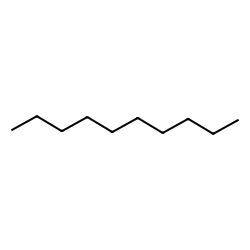
Cheméo RefData 1.0
One consistent value set for simulation, built from chemeo v31.
- Formula
- C10H22
- CAS
- 124-18-5
- Molecular Weight
- 142.28 g/mol
- SMILES
- CCCCCCCCCC
- InChI Key
- DIOQZVSQGTUSAI-UHFFFAOYSA-N
Constants
| Property | Value | Unit | u95 | Basis | Sources |
|---|---|---|---|---|---|
| MW Molecular Weight |
142.28 | g/mol | derived | ||
| Tc Critical Temperature |
617.70 | K | 0.70 | experimental | KDB; NIST Webbook; literature: 1, 2, 3 |
| Pc Critical Pressure |
2110.00 | kPa | 27.46 | experimental | KDB; NIST Webbook; literature: 1, 2, 3 |
| Vc Critical Volume |
0.624 | m3/kmol | 0.037 | experimental | KDB; NIST Webbook |
| Zc Critical Compressibility |
0.2563629 | derived | |||
| ω Acentric Factor |
0.4896 | derived | |||
| Tboil Normal Boiling Point Temperature |
447.25 | K | 0.54 | experimental | KDB; NIST Webbook; literature: 4, 5, 6, 7 |
| Tfus Normal melting (fusion) point |
243.40 | K | 0.36 | experimental | KDB; NIST Webbook; literature: 8 |
| ΔfH°gas Enthalpy of formation at standard conditions |
-249.70 | kJ/mol | 2.99 | experimental | KDB; NIST Webbook |
| ΔfG° Standard Gibbs free energy of formation |
33.24 | kJ/mol | 4.00 | experimental | KDB |
| Zra Rackett Parameter |
0.25 | 0.01 | experimental | KDB |
Equations
| Property | Equation | Temperature (K) | Fit |
|---|---|---|---|
| Pvap Vapor pressure |
Y = exp(A + B/T + C·ln(T) + D·T^E) Y in kPa, T in K |
[247.02; 617.70] | experimental, 205 points, AARD 0.6% against the measurements |
| A = 7.50415e+01, B = -8.64813e+03, C = -8.38186e+00, D = 8.55606e-18, E = 6.00000e+00 | |||
| Cp,gas Ideal gas heat capacity |
Y = A + B·((C/T)/sinh(C/T))² + D·((E/T)/cosh(E/T))² Y in J/mol×K, T in K |
[200.00; 1500.00] | compiled, 20 points, AARD 0.2% against its inputs, published equations only: agreement with those equations, not with measurements ChemSep v8.3 pure component data |
| A = 1.62419e+02, B = 5.29527e+02, C = 1.46331e+03, D = 3.28475e+02, E = 6.85039e+02 | |||
| Cp,liquid Liquid phase heat capacity |
Y = A + B·T + C·T² + D·T³ + E·T⁴ Y in J/mol×K, T in K |
[250.00; 360.00] | experimental, 50 points, AARD 0.2% against the measurements |
| A = 7.54311e+02, B = -4.73751e+00, C = 1.53425e-02, D = -1.47855e-05, E = 0.00000e+00 | |||
| ΔvapH Enthalpy of vaporization at a given temperature |
Y = A·(1 − Tr)^(B + C·Tr + D·Tr² + E·Tr³), Tr = T/Tc Y in kJ/mol, T in K |
[298.00; 555.93] | experimental, 18 points, AARD 0.7% against the measurements |
| A = 6.54775e+01, B = 2.29809e-01, C = 4.12911e-01, D = -2.64061e-01, E = 0.00000e+00, Tc = 6.17700e+02 K | |||
| ρl Liquid Density |
Y = A / B^(1 + (1 − T/C)^D) Y in kg/m3, T in K |
[243.51; 598.01] | compiled, 196 points, AARD 0.1% against its inputs, published equations only: agreement with those equations, not with measurements ChemSep v8.3 pure component data |
| A = 5.31277e+01, B = 2.40928e-01, C = 6.17700e+02, D = 2.69000e-01 | |||
| λliquid Liquid thermal conductivity |
Y = A + B·T + C·T² + D·T³ + E·T⁴ Y in W/m×K, T in K |
[243.15; 447.30] | compiled, 20 points, AARD 0.1% against its inputs, published equations only: agreement with those equations, not with measurements ChemSep v8.3 pure component data |
| A = 1.35615e-01, B = 4.35916e-04, C = -2.16600e-06, D = 2.22844e-09, E = 0.00000e+00 | |||
| λgas Gas thermal conductivity |
Y = A·T^B / (1 + C/T + D/T²) Y in W/m×K, T in K |
[243.51; 1000.00] | compiled, 20 points, AARD 0.0% against its inputs, published equations only: agreement with those equations, not with measurements ChemSep v8.3 pure component data |
| A = 1.63689e-07, B = 1.93275e+00, C = 0.00000e+00, D = 0.00000e+00 | |||
Equation of state
| Model | Tc (K) | Pc (kPa) | ω | c1 | c2 | c3 | Volume shift (m³/kmol) | Pvap AARD |
|---|---|---|---|---|---|---|---|---|
| PR | 617.70 | 2110.00 | 0.4896 | 1.09695e+00 | -2.61726e-01 | 7.70523e-01 | 1.04931e-02 | 0.7% |
| SRK | 617.70 | 2110.00 | 0.4896 | 1.28669e+00 | -6.43501e-01 | 1.23039e+00 | 4.20676e-02 | 0.8% |
a(T) = Ωa·R²·Tc²/Pc·α(T) and b = Ωb·R·Tc/Pc, with Pc in Pa and R = 8.314462618 J/(mol·K); PR: Ωa = 0.45724, Ωb = 0.07780; SRK: Ωa = 0.42748, Ωb = 0.08664.
Mathias-Copeman alpha function, with Tr = T/Tc:
α(T) = [1 + c1·(1 − √Tr) + c2·(1 − √Tr)² + c3·(1 − √Tr)³]² for T ≤ Tc,
α(T) = [1 + c1·(1 − √Tr)]² above Tc.
Péneloux volume shift: v = vEOS − volume shift, fitted to the liquid density at 0.7·Tc (0 when there is no liquid density).
A binary interaction parameter is valid only with these parameters, from RefData 1.0.
Binary interaction parameters
| Partner | Model | kij | Grade | Fit | Mixture data |
|---|---|---|---|---|---|
| 1-Hexanol | PR | 0.0648 | A | 44 points from 1 dataset, 398.38 to 411.62 K, at 40.0 kPa; AARD 2.2%, 16.0% at kij = 0 | 25-383-k |
| 1-Hexanol | SRK | 0.0675 | A | 44 points from 1 dataset, 398.38 to 411.62 K, at 40.0 kPa; AARD 2.2%, 16.3% at kij = 0 | 25-383-k |
| 2-Heptanone | PR | 0.0456 | A | 33 points from 1 dataset, 391.68 to 411.91 K, at 40.0 kPa; AARD 1.1%, 11.6% at kij = 0 | 19-897-g |
| 2-Heptanone | SRK | 0.0475 | A | 33 points from 1 dataset, 391.68 to 411.91 K, at 40.0 kPa; AARD 1.1%, 11.8% at kij = 0 | 19-897-g |
| Butane | PR | 0.0053 | B | 88 points from 1 dataset, 313.26 to 482.28 K, 160.0 to 4756.0 kPa; AARD 8.1%, 8.5% at kij = 0; a constant kij describes this system poorly, prefer an activity model | 26-023-h |
| Butane | SRK | 0.0054 | B | 89 points from 1 dataset, 313.26 to 482.28 K, 160.0 to 4756.0 kPa; AARD 8.1%, 8.4% at kij = 0; a constant kij describes this system poorly, prefer an activity model | 26-023-h |
| Carbon dioxide | PR | 0.1067 | A | 39 points from 4 datasets, 319.00 to 372.94 K, 1720.0 to 14240.0 kPa; AARD 2.6%, 30.5% at kij = 0 | 10-935-c |
| Carbon dioxide | SRK | 0.1158 | A | 46 points from 4 datasets, 319.00 to 372.94 K, 1720.0 to 14240.0 kPa; AARD 2.8%, 30.9% at kij = 0 | 10-935-c |
| Ethyl acetate | PR | 0.0803 | A | 19 points from 1 dataset, 350.37 to 433.02 K, at 101.3 kPa; AARD 3.0%, 16.8% at kij = 0 | 13-126-h |
| Ethyl acetate | SRK | 0.0845 | A | 19 points from 1 dataset, 350.37 to 433.02 K, at 101.3 kPa; AARD 3.0%, 17.1% at kij = 0 | 13-126-h |
| Ethyl formate | PR | 0.0747 | A | 21 points from 1 dataset, 328.43 to 426.41 K, at 101.3 kPa; AARD 4.2%, 21.1% at kij = 0 | 18-805-j |
| Ethyl formate | SRK | 0.0795 | A | 21 points from 1 dataset, 328.43 to 426.41 K, at 101.3 kPa; AARD 4.3%, 21.8% at kij = 0 | 18-805-j |
| m-Xylene | PR | -0.0048 | B | 17 points from 2 datasets, 361.71 to 441.55 K, 20.0 to 95.8 kPa; AARD 7.2%, 8.0% at kij = 0; a constant kij describes this system poorly, prefer an activity model | 13-384-b |
| m-Xylene | SRK | -0.0040 | B | 17 points from 2 datasets, 361.71 to 441.55 K, 20.0 to 95.8 kPa; AARD 7.2%, 7.7% at kij = 0; a constant kij describes this system poorly, prefer an activity model | 13-384-b |
| Methyl formate | PR | 0.0752 | B | 23 points from 1 dataset, 305.45 to 323.96 K, at 101.3 kPa; AARD 6.8%, 21.7% at kij = 0; a constant kij describes this system poorly, prefer an activity model | 18-804-k |
| Methyl formate | SRK | 0.0810 | B | 23 points from 1 dataset, 305.45 to 323.96 K, at 101.3 kPa; AARD 6.8%, 22.6% at kij = 0; a constant kij describes this system poorly, prefer an activity model | 18-804-k |
| o-Xylene | PR | -0.0202 | A | 16 points from 2 datasets, 366.11 to 434.95 K, 20.0 to 95.8 kPa; AARD 1.6%, 5.0% at kij = 0 | 13-383-c |
| o-Xylene | SRK | -0.0197 | A | 16 points from 2 datasets, 366.11 to 434.95 K, 20.0 to 95.8 kPa; AARD 1.7%, 4.7% at kij = 0 | 13-383-c |
| p-Xylene | PR | -0.0104 | A | 35 points from 3 datasets, 360.62 to 439.60 K, 20.0 to 97.3 kPa; AARD 3.3%, 4.1% at kij = 0 | 13-144-h |
| p-Xylene | SRK | -0.0095 | A | 35 points from 3 datasets, 360.62 to 439.60 K, 20.0 to 97.3 kPa; AARD 3.4%, 4.0% at kij = 0 | 13-144-h |
| Propane | PR | -0.0006 | A | 124 points from 1 dataset, 270.00 to 370.00 K, 62.8 to 2550.3 kPa; AARD 2.0%, 2.0% at kij = 0 | 16-592-h |
| Propane | SRK | 0.0001 | A | 124 points from 1 dataset, 270.00 to 370.00 K, 62.8 to 2550.3 kPa; AARD 2.2%, 2.2% at kij = 0 | 16-592-h |
| Propyl acetate | PR | 0.0519 | A | 31 points from 1 dataset, 374.35 to 444.79 K, at 101.3 kPa; AARD 1.3%, 11.7% at kij = 0 | 24-600-j |
| Propyl acetate | SRK | 0.0546 | A | 31 points from 1 dataset, 374.35 to 444.79 K, at 101.3 kPa; AARD 1.3%, 12.0% at kij = 0 | 24-600-j |
Grade A: the kij reproduces the measured pressures within 5% on average (AARD), B within 15%. A grade says how well one constant kij reproduces the measured points in its temperature and pressure range, nothing more: a pair that splits into two liquids is not described by it.
Not in RefData for this compound
Dynamic viscosity, Surface Tension.
Literature
- Experimental determination of critical data of multi-component mixtures containing potential gasoline additives 2-butanol by a flow-type apparatus
M. He, N. Xin, C. Wang, Y. Liu, Y. Zhang, X. Liu
10.1016/j.jct.2016.05.010, Vol. 101 (2016) - Measurement of Critical Properties for Binary and Ternary Mixtures Containing n-Butanol and n-Alkane
Chengjie Wang, Junshuai Chen, Muhammad Salman, Xiangyang Liu, Ying Zhang, Maogang He
10.1021/acs.jced.8b00585, Vol. 63 (2018) - Determination of the Critical Properties of C6 C10 n-Alkanes and Their Binary Systems Using a Flow Apparatus
Y. Liu, Y. Zhang, M. He, N. Xin
10.1021/je500756d, Vol. 59 (2014) - Phase equilibria of three binary systems containing 2,5-dimethylthiophene and 2-ethylthiophene in hydrocarbons
X. Wang, W. Xu, Y. Li, J. Wang, F. He
10.1016/j.fluid.2015.09.030, Vol. 409 (2016) - Densities and Excess Molar Properties of Dimethyl Carbonate with Alkanes (C6 to C10) and VLE of Dimethyl Carbonate with Alkanes (C9 to C10) at 101.3 kPa
J. Tojo, J. Canosa, A. Rodriguez, J. Ortega, R. Dieppa
10.1021/je0301794, Vol. 49 (2004) - Measurements of the Excess Properties and Vapor-Liquid Equilibria at 101.32 kPa for Mixtures of Ethyl Ethanoate + Alkanes (from C5 to C10)
L. Fernandez, E. Perez, J. Ortega, J. Canosa, J. Wisniak
10.1021/je100832h, Vol. 55 (2010) - Multiproperty Correlation of Experimental Data of the Binaries Propyl Ethanoate + Alkanes (Pentane to Decane). New Experimental Information for Vapor Liquid Equilibrium and Mixing Properties
L. Fernandez, J. Ortega, E. Perez, F. Toledo, J. Canosa
10.1021/je3011979, Vol. 58 (2013) - Solid Liquid Equilibria, Excess Molar Volumes, and Deviations in the Molar Refractivity for the Binary Systems of Alamine 304-1 + Decane, Dodecane, or Dodecanol
I. Jeong, R.-H. Kwon, S.-J. Park, Y.-Y. Choi
10.1021/je400606c, Vol. 59 (2014)
Checks
Deviation from the compiled data (ChemSep, ChEDL): Critical Temperature: 0.0%; Critical Pressure: 0.0%; Critical Volume: 0.0%; Normal Boiling Point Temperature: 0.0%; Normal melting (fusion) point: 0.0%; Enthalpy of formation at standard conditions: 0.24 kJ/mol; Standard Gibbs free energy of formation: 0.06 kJ/mol; Rackett Parameter: 0.2%; Liquid phase heat capacity: 0.5%; Enthalpy of vaporization at a given temperature: 1.1%.