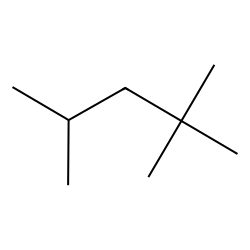
Cheméo RefData 1.0
One consistent value set for simulation, built from chemeo v31.
- Formula
- C8H18
- CAS
- 540-84-1
- Molecular Weight
- 114.23 g/mol
- SMILES
- CC(C)CC(C)(C)C
- InChI Key
- NHTMVDHEPJAVLT-UHFFFAOYSA-N
Constants
| Property | Value | Unit | u95 | Basis | Sources |
|---|---|---|---|---|---|
| MW Molecular Weight |
114.23 | g/mol | derived | ||
| Tc Critical Temperature |
543.82 | K | 0.64 | experimental | KDB; NIST Webbook; literature: 1, 2 |
| Pc Critical Pressure |
2564.33 | kPa | 23.81 | experimental | KDB; NIST Webbook; literature: 2 |
| Vc Critical Volume |
0.468 | m3/kmol | 0.028 | experimental | KDB; NIST Webbook |
| Zc Critical Compressibility |
0.2654180 | derived | |||
| ω Acentric Factor |
0.3038 | derived | |||
| Tboil Normal Boiling Point Temperature |
372.37 | K | 0.29 | experimental | KDB; NIST Webbook; literature: 3, 4, 5, 6, 7, 8, 9, 10 |
| Tfus Normal melting (fusion) point |
165.77 | K | 0.22 | experimental | KDB; Aqueous Solubility Prediction Method; NIST Webbook |
| ΔfH°gas Enthalpy of formation at standard conditions |
-224.10 | kJ/mol | 3.38 | experimental | KDB; NIST Webbook |
| ΔfG° Standard Gibbs free energy of formation |
13.69 | kJ/mol | 4.00 | experimental | KDB |
| Zra Rackett Parameter |
0.27 | 0.01 | experimental | KDB |
Equations
| Property | Equation | Temperature (K) | Fit |
|---|---|---|---|
| Pvap Vapor pressure |
Y = exp(A + B/T + C·ln(T) + D·T^E) Y in kPa, T in K |
[165.78; 543.82] | experimental, 160 points, AARD 0.7% against the measurements |
| A = 1.14069e+02, B = -7.53824e+03, C = -1.61579e+01, D = 1.73130e-02, E = 1.00000e+00 | |||
| Cp,gas Ideal gas heat capacity |
Y = A + B·((C/T)/sinh(C/T))² + D·((E/T)/cosh(E/T))² Y in J/mol×K, T in K |
[200.00; 1500.00] | compiled, 20 points, AARD 0.2% against its inputs, published equations only: agreement with those equations, not with measurements ChemSep v8.3 pure component data |
| A = 1.09761e+02, B = 5.22461e+02, C = 1.49011e+03, D = 3.06686e+02, E = 6.38230e+02 | |||
| Cp,liquid Liquid phase heat capacity |
Y = A + B·T + C·T² + D·T³ + E·T⁴ Y in J/mol×K, T in K |
[170.00; 370.00] | experimental, 34 points, AARD 0.3% against the measurements |
| A = 1.65279e+02, B = -1.04744e-01, C = 1.54082e-03, D = -1.22371e-06, E = 0.00000e+00 | |||
| ΔvapH Enthalpy of vaporization at a given temperature |
Y = A·(1 − Tr)^(B + C·Tr + D·Tr² + E·Tr³), Tr = T/Tc Y in kJ/mol, T in K |
[271.91; 489.44] | experimental, 20 points, AARD 0.2% against the measurements |
| A = 7.00967e+01, B = 1.89154e+00, C = -2.46267e+00, D = 1.08250e+00, E = 0.00000e+00, Tc = 5.43820e+02 K | |||
| ρl Liquid Density |
Y = A + B·T + C·T² + D·T³ + E·T⁴ Y in kg/m3, T in K |
[165.78; 523.99] | compiled, 169 points, AARD 0.1% against its inputs, published equations only: agreement with those equations, not with measurements ChemSep v8.3 pure component data |
| A = 6.56908e+02, B = 2.90253e+00, C = -1.87348e-02, D = 4.18049e-05, E = -3.50638e-08 | |||
| λliquid Liquid thermal conductivity |
Y = A + B·T + C·T² + D·T³ + E·T⁴ Y in W/m×K, T in K |
[259.11; 328.14] | experimental, 15 points, AARD 0.1% against the measurements |
| A = 1.27877e-01, B = 2.07275e-04, C = -1.71326e-06, D = 2.16077e-09, E = 0.00000e+00 | |||
| λgas Gas thermal conductivity |
Y = A·T^B / (1 + C/T + D/T²) Y in W/m×K, T in K |
[165.78; 1000.00] | compiled, 20 points, AARD 0.0% against its inputs, published equations only: agreement with those equations, not with measurements ChemSep v8.3 pure component data |
| A = 1.14010e-05, B = 1.36320e+00, C = 2.86230e+02, D = 6.06520e+03 | |||
| γ Surface Tension |
Y = A·(1 − Tr)^(B + C·Tr + D·Tr² + E·Tr³), Tr = T/Tc Y in N/m, T in K |
[288.15; 323.15] | experimental, 29 points, AARD 0.5% against the measurements |
| A = 1.27480e-13, B = -1.26476e+02, C = 2.50057e+02, D = -1.42908e+02, E = 0.00000e+00, Tc = 5.43820e+02 K | |||
Equation of state
| Model | Tc (K) | Pc (kPa) | ω | c1 | c2 | c3 | Volume shift (m³/kmol) | Pvap AARD |
|---|---|---|---|---|---|---|---|---|
| PR | 543.82 | 2564.33 | 0.3038 | 8.21813e-01 | -1.08340e-01 | 4.55763e-01 | -5.78651e-03 | 0.0% |
| SRK | 543.82 | 2564.33 | 0.3038 | 9.90669e-01 | -4.33626e-01 | 8.33856e-01 | 1.78529e-02 | 0.1% |
a(T) = Ωa·R²·Tc²/Pc·α(T) and b = Ωb·R·Tc/Pc, with Pc in Pa and R = 8.314462618 J/(mol·K); PR: Ωa = 0.45724, Ωb = 0.07780; SRK: Ωa = 0.42748, Ωb = 0.08664.
Mathias-Copeman alpha function, with Tr = T/Tc:
α(T) = [1 + c1·(1 − √Tr) + c2·(1 − √Tr)² + c3·(1 − √Tr)³]² for T ≤ Tc,
α(T) = [1 + c1·(1 − √Tr)]² above Tc.
Péneloux volume shift: v = vEOS − volume shift, fitted to the liquid density at 0.7·Tc (0 when there is no liquid density).
A binary interaction parameter is valid only with these parameters, from RefData 1.0.
Binary interaction parameters
| Partner | Model | kij | Grade | Fit | Mixture data |
|---|---|---|---|---|---|
| 1-Butanol | PR | 0.0430 | B | 71 points from 4 datasets, 313.15 to 388.96 K, 5.4 to 101.3 kPa; AARD 8.6%, 19.9% at kij = 0; a constant kij describes this system poorly, prefer an activity model | 10-441-a |
| 1-Butanol | SRK | 0.0445 | B | 71 points from 4 datasets, 313.15 to 388.96 K, 5.4 to 101.3 kPa; AARD 8.6%, 20.1% at kij = 0; a constant kij describes this system poorly, prefer an activity model | 10-441-a |
| 1-Pentanol | PR | 0.0350 | B | 26 points from 2 datasets, at 313.15 K, 3.4 to 13.0 kPa; AARD 11.9%, 21.6% at kij = 0; a constant kij describes this system poorly, prefer an activity model | 12-349-b |
| 1-Pentanol | SRK | 0.0358 | B | 26 points from 2 datasets, at 313.15 K, 3.4 to 13.0 kPa; AARD 11.9%, 21.6% at kij = 0; a constant kij describes this system poorly, prefer an activity model | 12-349-b |
| 1-Propanol | PR | 0.0550 | B | 22 points from 1 dataset, at 318.15 K, 9.0 to 21.1 kPa; AARD 10.5%, 20.7% at kij = 0; a constant kij describes this system poorly, prefer an activity model | 12-408-f |
| 1-Propanol | SRK | 0.0577 | B | 22 points from 1 dataset, at 318.15 K, 9.0 to 21.1 kPa; AARD 10.5%, 21.1% at kij = 0; a constant kij describes this system poorly, prefer an activity model | 12-408-f |
| 2-Butanol | PR | 0.0588 | B | 24 points from 1 dataset, at 313.15 K, 8.7 to 15.4 kPa; AARD 6.7%, 21.5% at kij = 0; a constant kij describes this system poorly, prefer an activity model | 27-515-a |
| 2-Butanol | SRK | 0.0607 | B | 24 points from 1 dataset, at 313.15 K, 8.7 to 15.4 kPa; AARD 6.7%, 21.7% at kij = 0; a constant kij describes this system poorly, prefer an activity model | 27-515-a |
| Acetone | PR | 0.0883 | A | 19 points from 1 dataset, 328.74 to 364.14 K, at 101.3 kPa; AARD 4.5%, 23.9% at kij = 0 | 13-558-j |
| Acetone | SRK | 0.0925 | A | 19 points from 1 dataset, 328.74 to 364.14 K, at 101.3 kPa; AARD 4.5%, 24.3% at kij = 0 | 13-558-j |
| Carbon dioxide | PR | 0.0966 | A | 132 points from 1 dataset, 278.15 to 393.15 K, 1200.0 to 11100.0 kPa; AARD 4.7%, 26.6% at kij = 0 | 13-300-d |
| Carbon dioxide | SRK | 0.1061 | A | 134 points from 1 dataset, 278.15 to 393.15 K, 1200.0 to 11100.0 kPa; AARD 4.7%, 27.1% at kij = 0 | 13-300-d |
| Dimethoxymethane | PR | 0.0706 | A | 10 points from 1 dataset, 314.55 to 352.75 K, at 96.0 kPa; AARD 1.2%, 20.0% at kij = 0 | 17-858-b |
| Dimethoxymethane | SRK | 0.0739 | A | 10 points from 1 dataset, 314.55 to 352.75 K, at 96.0 kPa; AARD 1.2%, 20.3% at kij = 0 | 17-858-b |
| Ethane | PR | 0.0069 | A | 44 points from 1 dataset, 303.15 to 333.15 K, 580.0 to 6230.0 kPa; AARD 1.5%, 2.9% at kij = 0 | 22-618-b |
| Ethane | SRK | 0.0044 | A | 44 points from 1 dataset, 303.15 to 333.15 K, 580.0 to 6230.0 kPa; AARD 1.4%, 2.1% at kij = 0 | 22-618-b |
| Ethanol | PR | 0.0426 | B | 84 points from 5 datasets, 343.95 to 362.55 K, 95.8 to 101.3 kPa; AARD 10.5%, 18.0% at kij = 0; a constant kij describes this system poorly, prefer an activity model | 10-487-a |
| Ethanol | SRK | 0.0474 | B | 84 points from 5 datasets, 343.95 to 362.55 K, 95.8 to 101.3 kPa; AARD 10.5%, 18.8% at kij = 0; a constant kij describes this system poorly, prefer an activity model | 10-487-a |
| Ethyl acetate | PR | 0.0498 | A | 95 points from 2 datasets, 308.15 to 502.65 K, 13.5 to 1500.0 kPa; AARD 2.0%, 10.1% at kij = 0 | 16-886-b |
| Ethyl acetate | SRK | 0.0524 | A | 95 points from 2 datasets, 308.15 to 502.65 K, 13.5 to 1500.0 kPa; AARD 2.1%, 10.2% at kij = 0 | 16-886-b |
| Ethylbenzene | PR | -0.0133 | A | 17 points from 1 dataset, 408.80 to 444.40 K, at 250.0 kPa; AARD 0.8%, 3.0% at kij = 0 | 23-049-c |
| Ethylbenzene | SRK | -0.0138 | A | 17 points from 1 dataset, 408.80 to 444.40 K, at 250.0 kPa; AARD 0.8%, 3.0% at kij = 0 | 23-049-c |
| Heptane | PR | -0.0011 | A | 22 points from 1 dataset, at 313.15 K, 12.3 to 12.9 kPa; AARD 0.1%, 0.3% at kij = 0 | 11-230-d |
| Heptane | SRK | -0.0012 | A | 22 points from 1 dataset, at 313.15 K, 12.3 to 12.9 kPa; AARD 0.1%, 0.4% at kij = 0 | 11-230-d |
| Isopropanol | PR | 0.0676 | B | 119 points from 4 datasets, 330.00 to 361.23 K, 28.2 to 101.3 kPa; AARD 6.8%, 18.8% at kij = 0; a constant kij describes this system poorly, prefer an activity model | 12-470-g |
| Isopropanol | SRK | 0.0708 | B | 119 points from 4 datasets, 330.00 to 361.23 K, 28.2 to 101.3 kPa; AARD 6.8%, 19.2% at kij = 0; a constant kij describes this system poorly, prefer an activity model | 12-470-g |
| m-Xylene | PR | -0.0174 | A | 22 points from 2 datasets, 372.05 to 448.20 K, 95.8 to 250.0 kPa; AARD 1.5%, 3.4% at kij = 0 | 12-076-e |
| m-Xylene | SRK | -0.0182 | A | 22 points from 2 datasets, 372.05 to 448.20 K, 95.8 to 250.0 kPa; AARD 1.5%, 3.4% at kij = 0 | 12-076-e |
| Methyl acetate | PR | 0.0677 | A | 67 points from 1 dataset, 329.52 to 499.45 K, 100.0 to 1500.0 kPa; AARD 2.7%, 13.4% at kij = 0 | 20-688-g |
| Methyl acetate | SRK | 0.0715 | A | 67 points from 1 dataset, 329.52 to 499.45 K, 100.0 to 1500.0 kPa; AARD 2.8%, 13.8% at kij = 0 | 20-688-g |
| o-Xylene | PR | -0.0219 | A | 19 points from 1 dataset, 410.60 to 455.00 K, at 250.0 kPa; AARD 0.9%, 4.8% at kij = 0 | 23-050-a |
| o-Xylene | SRK | -0.0230 | A | 19 points from 1 dataset, 410.60 to 455.00 K, at 250.0 kPa; AARD 0.9%, 4.8% at kij = 0 | 23-050-a |
| p-Xylene | PR | -0.0144 | A | 18 points from 2 datasets, 372.75 to 447.50 K, 95.8 to 250.0 kPa; AARD 1.0%, 3.2% at kij = 0 | 12-077-d |
| p-Xylene | SRK | -0.0151 | A | 18 points from 2 datasets, 372.75 to 447.50 K, 95.8 to 250.0 kPa; AARD 1.1%, 3.2% at kij = 0 | 12-077-d |
| tert-Butyl methyl ether | PR | 0.0118 | A | 31 points from 2 datasets, 318.10 to 361.25 K, 19.7 to 96.0 kPa; AARD 0.7%, 3.5% at kij = 0 | 10-763-d |
| tert-Butyl methyl ether | SRK | 0.0125 | A | 31 points from 2 datasets, 318.10 to 361.25 K, 19.7 to 96.0 kPa; AARD 0.7%, 3.7% at kij = 0 | 10-763-d |
| Thiophene | PR | -0.0018 | A | 33 points from 1 dataset, 343.15 to 353.15 K, 44.3 to 93.2 kPa; AARD 0.5%, 0.6% at kij = 0 | 12-782-a |
| Thiophene | SRK | 0.0002 | A | 33 points from 1 dataset, 343.15 to 353.15 K, 44.3 to 93.2 kPa; AARD 0.5%, 0.5% at kij = 0 | 12-782-a |
Grade A: the kij reproduces the measured pressures within 5% on average (AARD), B within 15%. A grade says how well one constant kij reproduces the measured points in its temperature and pressure range, nothing more: a pair that splits into two liquids is not described by it.
Not in RefData for this compound
Dynamic viscosity.
Literature
- The Critical Temperatures of a Number of (i) (Chloroalkane (C3 C4) + Hydrocarbon (C6 C7)) Binary Mixtures and (ii) (Aromatic Halocarbon (Chlorobenzene, Fluorobenzene, 1,2-Dichlorobenzene, or 1,3-Dichlorobenzene) + Alkane (C8)) Binary Mixtures
C. L. Young, C. A. Tran, D. W. Morton
10.1021/acs.jced.7b00191, Vol. 62 (2017) - Critical Temperatures and Pressures of Several Binary and Ternary Mixtures Concerning the Alkylation of 2-Methylpropane with 1-Butene in the Presence of Methane or Carbon Dioxide
J. Li, Z. Qin, G. Wang, M. Dong, J. Wang
10.1021/je700132w, Vol. 52 (2007) - Phase equilibria for binary systems of octane boosters with 2,2,4-trimethylpentane
K. V. N. S. Reddy, D.H.L. Prasad, A. Krishnaiah
10.1016/j.fluid.2004.12.007, Vol. 230 (2005) - Isobaric vapor liquid equilibria for mixtures of acetone, ethanol, and 2,2,4-trimethylpentane at 101.3 kPa
H. -C. Ku, C. -H. Tu
10.1016/j.fluid.2005.01.007, Vol. 231 (2005) - Vapor liquid equilibria for binary and ternary mixtures of diisopropyl ether, ethanol, and 2,2,4-trimethylpentane at 101.3 kPa
H. -C. Ku, C. -H. Tu
10.1016/j.fluid.2006.08.004, Vol. 248 (2006) - Measurements and correlation of vapour liquid equilibria of 2-butanone and hydrocarbons binary systems at two different pressures
E. Lladosa, N. F. Martinez, J. B. Monton, J. d. l. Torre
10.1016/j.fluid.2011.05.004, Vol. 307 (2011) - Isobaric vapor-liquid equilibrium, density and speed of sound of binary mixtures 2,2,4-trimethylpentane + 1-butanol or dibutyl ether (DBE) at 101.3 kPa
Gabriel Rubio-Perez, Natalia Munoz-Rujas, Adil Srhiyer, Eduardo A. Montero, Fernando Aguilar
10.1016/j.fluid.2018.07.027, Vol. 475 (2018) - Low-Pressure VLE Measurements and Thermodynamic Modeling, with PSRK and NRTL, of Binary 1-Alcohol + n-Alkane Systems
Machelle Ferreira, Cara E. Schwarz
10.1021/acs.jced.8b00680, Vol. 63 (2018) - Vapor-Liquid Equilibrium of Ferrocene in Some Organic Solvents Using Spectroscopic Methods
M. A. Siddiqi, B. Atakan
10.1021/je060002k, Vol. 51 (2006) - Vapor-Liquid Equilibrium for Binary System of Diethyl Sulfide + n-Heptane and Diethyl Sulfide + 2,2,4-Trimethylpentane at (363.15 and 353.15) K
E. Sapei, A. Zaytseva, P. Uusi-Kyyny, K. I. Keskinen, J. Aittamaa
10.1021/je060351e, Vol. 52 (2007)
Checks
Deviation from the compiled data (ChemSep, ChEDL): Critical Temperature: 0.0%; Critical Pressure: 0.2%; Critical Volume: 0.4%; Normal Boiling Point Temperature: 0.0%; Normal melting (fusion) point: 0.0%; Enthalpy of formation at standard conditions: 0.09 kJ/mol; Standard Gibbs free energy of formation: 0.25 kJ/mol; Rackett Parameter: 0.4%; Vapor pressure: 2.1%; Liquid phase heat capacity: 0.4%; Enthalpy of vaporization at a given temperature: 1.3%; Liquid thermal conductivity: 4.0%; Surface Tension: 0.4%.