Cheméo RefData 1.0
One consistent value set for simulation, built from chemeo v31.
- Formula
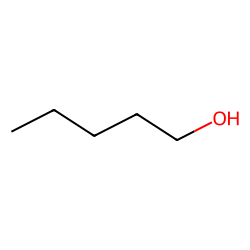
- C5H12O
- CAS
- 71-41-0
- Molecular Weight
- 88.15 g/mol
- SMILES
- CCCCCO
- InChI Key
- AMQJEAYHLZJPGS-UHFFFAOYSA-N
Constants
| Property | Value | Unit | u95 | Basis | Sources |
|---|---|---|---|---|---|
| MW Molecular Weight |
88.15 | g/mol | derived | ||
| Tc Critical Temperature |
588.10 | K | 0.63 | experimental | KDB; NIST Webbook |
| Pc Critical Pressure |
3900.00 | kPa | 35.31 | experimental | KDB; NIST Webbook |
| Vc Critical Volume |
0.326 | m3/kmol | 0.020 | experimental | KDB; NIST Webbook |
| Zc Critical Compressibility |
0.2600141 | derived | |||
| ω Acentric Factor |
0.5758 | derived | |||
| Tboil Normal Boiling Point Temperature |
411.00 | K | 1.02 | experimental | KDB; NIST Webbook; NCMS SOLV-DB; literature: 1, 2, 3, 4, 5, 6, 7, 8, 9, 10, 11, 12, 13, 14, 15, 16, 17, 18 |
| Tfus Normal melting (fusion) point |
194.35 | K | 1.09 | experimental | KDB; Aqueous Solubility Prediction Method; NIST Webbook; NCMS SOLV-DB |
| ΔfH°gas Enthalpy of formation at standard conditions |
-294.70 | kJ/mol | 9.62 | experimental | KDB; NIST Webbook |
| ΔfG° Standard Gibbs free energy of formation |
-146.10 | kJ/mol | 4.00 | experimental | KDB |
| Zra Rackett Parameter |
0.26 | 0.01 | experimental | KDB |
Equations
| Property | Equation | Temperature (K) | Fit |
|---|---|---|---|
| Pvap Vapor pressure |
Y = exp(A + B/T + C·ln(T) + D·T^E) Y in kPa, T in K |
[195.56; 588.10] | experimental, 176 points, AARD 1.4% against the measurements |
| A = 1.84063e+02, B = -1.28909e+04, C = -2.59554e+01, D = 1.97919e-02, E = 1.00000e+00 | |||
| Cp,gas Ideal gas heat capacity |
Y = A + B·((C/T)/sinh(C/T))² + D·((E/T)/cosh(E/T))² Y in J/mol×K, T in K |
[200.00; 1500.00] | compiled, 36 points, AARD 0.6% against its inputs, published equations only: agreement with those equations, not with measurements ChemSep v8.3 pure component data |
| A = 8.98250e+01, B = 3.05083e+02, C = 1.56284e+03, D = 2.06016e+02, E = 6.98088e+02 | |||
| Cp,liquid Liquid phase heat capacity |
Y = A + B·T + C·T² + D·T³ + E·T⁴ Y in J/mol×K, T in K |
[293.15; 313.20] | experimental, 14 points, AARD 0.6% against the measurements |
| A = -5.23557e+05, B = 5.23627e+03, C = -1.74472e+01, D = 1.93754e-02, E = 0.00000e+00 | |||
| ΔvapH Enthalpy of vaporization at a given temperature |
Y = A·(1 − Tr)^(B + C·Tr + D·Tr² + E·Tr³), Tr = T/Tc Y in kJ/mol, T in K |
[294.05; 548.00] | experimental, 25 points, AARD 0.6% against the measurements |
| A = 6.56789e+01, B = -4.05828e-01, C = 1.53987e+00, D = -7.09103e-01, E = 0.00000e+00, Tc = 5.88100e+02 K | |||
| ρl Liquid Density |
Y = A / B^(1 + (1 − T/C)^D) Y in kg/m3, T in K |
[195.56; 567.44] | compiled, 321 points, AARD 0.1% against its inputs, published equations only: agreement with those equations, not with measurements ChemSep v8.3 pure component data |
| A = 4.37517e+01, B = 2.09601e-01, C = 5.88100e+02, D = 1.99000e-01 | |||
| η Dynamic viscosity |
Y = exp(A + B/T + C·ln(T) + D·T^E) Y in Pa×s, T in K |
[283.15; 373.15] | experimental, 113 points, AARD 0.6% against the measurements |
| A = -2.05125e+01, B = 2.82056e+03, C = 9.46470e-01, D = 0.00000e+00, E = 0.00000e+00 | |||
| λliquid Liquid thermal conductivity |
Y = A + B·T + C·T² + D·T³ + E·T⁴ Y in W/m×K, T in K |
[273.15; 373.15] | compiled, 20 points, AARD 0.3% against its inputs, published equations only: agreement with those equations, not with measurements ChemSep v8.3 pure component data |
| A = -3.60978e-01, B = 5.56231e-03, C = -1.92367e-05, D = 2.13891e-08, E = 0.00000e+00 | |||
| λgas Gas thermal conductivity |
Y = A·T^B / (1 + C/T + D/T²) Y in W/m×K, T in K |
[195.56; 990.95] | compiled, 20 points, AARD 0.9% against its inputs, published equations only: agreement with those equations, not with measurements ChemSep v8.3 pure component data |
| A = 2.90651e-07, B = 1.86112e+00, C = 0.00000e+00, D = 0.00000e+00 | |||
| γ Surface Tension |
Y = A·(1 − Tr)^(B + C·Tr + D·Tr² + E·Tr³), Tr = T/Tc Y in N/m, T in K |
[293.15; 323.15] | experimental, 26 points, AARD 0.9% against the measurements |
| A = 4.58907e+03, B = 5.86794e+01, C = -1.17554e+02, D = 7.02382e+01, E = 0.00000e+00, Tc = 5.88100e+02 K | |||
Equation of state
| Model | Tc (K) | Pc (kPa) | ω | c1 | c2 | c3 | Volume shift (m³/kmol) | Pvap AARD |
|---|---|---|---|---|---|---|---|---|
| PR | 588.10 | 3900.00 | 0.5758 | 9.78655e-01 | 1.45547e+00 | -1.29288e+00 | -5.95965e-04 | 0.3% |
| SRK | 588.10 | 3900.00 | 0.5758 | 1.16343e+00 | 1.15689e+00 | -9.53776e-01 | 1.54701e-02 | 0.2% |
a(T) = Ωa·R²·Tc²/Pc·α(T) and b = Ωb·R·Tc/Pc, with Pc in Pa and R = 8.314462618 J/(mol·K); PR: Ωa = 0.45724, Ωb = 0.07780; SRK: Ωa = 0.42748, Ωb = 0.08664.
Mathias-Copeman alpha function, with Tr = T/Tc:
α(T) = [1 + c1·(1 − √Tr) + c2·(1 − √Tr)² + c3·(1 − √Tr)³]² for T ≤ Tc,
α(T) = [1 + c1·(1 − √Tr)]² above Tc.
Péneloux volume shift: v = vEOS − volume shift, fitted to the liquid density at 0.7·Tc (0 when there is no liquid density).
A binary interaction parameter is valid only with these parameters, from RefData 1.0.
Binary interaction parameters
| Partner | Model | kij | Grade | Fit | Mixture data |
|---|---|---|---|---|---|
| 1-Butanol | PR | -0.0052 | A | 19 points from 1 dataset, 392.02 to 410.00 K, at 101.0 kPa; AARD 0.6%, 1.6% at kij = 0 | 14-504-g |
| 1-Butanol | SRK | -0.0051 | A | 19 points from 1 dataset, 392.02 to 410.00 K, at 101.0 kPa; AARD 0.6%, 1.5% at kij = 0 | 14-504-g |
| 1-Propanol | PR | 0.0077 | A | 19 points from 1 dataset, 370.21 to 406.39 K, at 101.3 kPa; AARD 0.9%, 2.6% at kij = 0 | 11-614-h |
| 1-Propanol | SRK | 0.0085 | A | 19 points from 1 dataset, 370.21 to 406.39 K, at 101.3 kPa; AARD 1.0%, 2.7% at kij = 0 | 11-614-h |
| 2,2,4-Trimethylpentane | PR | 0.0350 | B | 26 points from 2 datasets, at 313.15 K, 3.4 to 13.0 kPa; AARD 11.9%, 21.6% at kij = 0; a constant kij describes this system poorly, prefer an activity model | 12-349-b |
| 2,2,4-Trimethylpentane | SRK | 0.0358 | B | 26 points from 2 datasets, at 313.15 K, 3.4 to 13.0 kPa; AARD 11.9%, 21.6% at kij = 0; a constant kij describes this system poorly, prefer an activity model | 12-349-b |
| Carbon dioxide | PR | 0.1229 | B | 26 points from 1 dataset, 293.15 to 333.15 K, 510.0 to 8480.0 kPa; AARD 7.2%, 53.1% at kij = 0; a constant kij describes this system poorly, prefer an activity model | 12-903-f |
| Carbon dioxide | SRK | 0.1254 | B | 26 points from 1 dataset, 293.15 to 333.15 K, 510.0 to 8480.0 kPa; AARD 7.0%, 51.9% at kij = 0; a constant kij describes this system poorly, prefer an activity model | 12-903-f |
| Cyclohexane | PR | 0.1166 | A | 13 points from 1 dataset, 353.80 to 354.70 K, at 101.3 kPa; AARD 0.2%, 2.0% at kij = 0 | 15-919-f |
| Cyclohexane | SRK | 0.1195 | A | 13 points from 1 dataset, 353.80 to 354.70 K, at 101.3 kPa; AARD 0.2%, 2.0% at kij = 0 | 15-919-f |
| Ethyl acetate | PR | 0.0209 | A | 21 points from 1 dataset, 351.96 to 406.75 K, at 101.3 kPa; AARD 0.6%, 6.3% at kij = 0 | 12-998-b |
| Ethyl acetate | SRK | 0.0213 | A | 21 points from 1 dataset, 351.96 to 406.75 K, at 101.3 kPa; AARD 0.6%, 6.3% at kij = 0 | 12-998-b |
| Heptane | PR | 0.0585 | B | 68 points from 3 datasets, 313.15 to 406.85 K, 6.3 to 91.3 kPa; AARD 7.2%, 18.8% at kij = 0; a constant kij describes this system poorly, prefer an activity model | 12-350-k |
| Heptane | SRK | 0.0597 | B | 68 points from 3 datasets, 313.15 to 406.85 K, 6.3 to 91.3 kPa; AARD 7.2%, 18.8% at kij = 0; a constant kij describes this system poorly, prefer an activity model | 12-350-k |
| Hexane | PR | 0.1517 | A | 13 points from 1 dataset, 341.90 to 342.90 K, at 101.3 kPa; AARD 0.4%, 3.1% at kij = 0 | 11-973-k |
| Hexane | SRK | 0.1569 | A | 13 points from 1 dataset, 341.90 to 342.90 K, at 101.3 kPa; AARD 0.4%, 3.2% at kij = 0 | 11-973-k |
| Isobutanol | PR | 0.0017 | A | 20 points from 1 dataset, 382.53 to 409.10 K, at 101.3 kPa; AARD 0.3%, 0.6% at kij = 0 | 26-710-e |
| Isobutanol | SRK | 0.0020 | A | 20 points from 1 dataset, 382.53 to 409.10 K, at 101.3 kPa; AARD 0.3%, 0.6% at kij = 0 | 26-710-e |
| Isopropanol | PR | -0.0043 | A | 24 points from 1 dataset, 357.45 to 408.68 K, at 101.0 kPa; AARD 0.7%, 1.6% at kij = 0 | 14-503-h |
| Isopropanol | SRK | -0.0042 | A | 24 points from 1 dataset, 357.45 to 408.68 K, at 101.0 kPa; AARD 0.7%, 1.5% at kij = 0 | 14-503-h |
| Nonane | PR | 0.0616 | A | 75 points from 3 datasets, 368.52 to 412.69 K, 26.7 to 101.3 kPa; AARD 4.0%, 17.2% at kij = 0 | 17-053-e |
| Nonane | SRK | 0.0642 | A | 75 points from 3 datasets, 368.52 to 412.69 K, 26.7 to 101.3 kPa; AARD 4.0%, 17.4% at kij = 0 | 17-053-e |
| Propyl acetate | PR | -0.0010 | A | 19 points from 1 dataset, 376.30 to 409.50 K, at 101.3 kPa; AARD 0.8%, 0.9% at kij = 0 | 27-334-b |
| Propyl acetate | SRK | -0.0009 | A | 19 points from 1 dataset, 376.30 to 409.50 K, at 101.3 kPa; AARD 0.8%, 0.8% at kij = 0 | 27-334-b |
Grade A: the kij reproduces the measured pressures within 5% on average (AARD), B within 15%. A grade says how well one constant kij reproduces the measured points in its temperature and pressure range, nothing more: a pair that splits into two liquids is not described by it.
Literature
- Excess molar volumes of ternary mixtures of 1,3-dichlorobenzene and methyl ethyl ketone with 1-alkanols at 303.15K
J. Rajasekar, K. Sivakumar
10.1016/j.fluid.2006.04.010, Vol. 245 (2006) - Vapor liquid equilibria in the ternary system dipropyl ether + 1-propanol + 1-pentanol and the binary systems dipropyl ether + 1-pentanol, 1-propanol + 1-pentanol at 101.3 kPa
E. Lladosa, J. B. Monton, M. C. Burguet, R. Munoz
10.1016/j.fluid.2006.07.003, Vol. 247 (2006) - Investigation on vapor liquid equilibrium for 2-propanol + 1-butanol + 1-pentanol at 101.3 kPa
J. Wang, Z. Bao
10.1016/j.fluid.2012.12.020, Vol. 341 (2013) - Liquid-liquid equilibrium data for ternary aqueous mixtures containing 1-pentanol and 2-methyl-1-propanol at (298.15, 323.15, and 348.15) K
J. Yang, Y. Liu, Y. Ma, Q. Meng, Y. Wang
10.1016/j.fluid.2013.03.029, Vol. 349 (2013) - Isobaric Phase Equilibria of Diethyl Carbonate with Five Alcohols at 101.3 kPa
A. Rodriguez, J. Canosa, A. Dominguez, J. Tojo
10.1021/je0201018, Vol. 48 (2003) - Density, Refractive Index, and Speed of Sound at 298.15 K and Vapor-Liquid Equilibria at 101.3 kPa for Binary Mixtures of Ethyl Acetate + 1-Pentanol and Ethanol + 2-Methyl-1-propanol
J. M. Resa, C. Gonzalez, J. M. Goenaga, M. Iglesias
10.1021/je030218b, Vol. 49 (2004) - Vapor-Liquid Equilibria of the Binary System 1-Pentanol + Anisole and the Quaternary System Benzene+Cyclohexane+1-Pentanol+Anisole at 101.32 kPa
B. Orge, G. M. Foco, E. A. Brignole
10.1021/je034189g, Vol. 49 (2004) - Quaternary Liquid-Liquid Equilibrium of Water + Acetic Acid + Propionic Acid + Solvent (Amyl Alcohol, Cyclohexyl Acetate, or Toluene) Systems
S. Cehreli, M. Bilgin
10.1021/je049848j, Vol. 49 (2004) - Isobaric Vapor-Liquid Equilibria of the Ternary System Methylbutyl Ketone + 1-Pentanol + Nonane
H. Kirss, E. Siimer, M. Kuus
10.1021/je0502905, Vol. 51 (2006) - Isobaric Vapor-Liquid Equilibria of the Ternary System Dibutyl Ether + 1-Pentanol + Nonane
H. Kirss, M. Kuus, E. Siimer
10.1021/je060237w, Vol. 51 (2006) - Vapor-Liquid Equilibria at 101.3 kPa for Binary Mixtures Containing 2-Methyl-1-propanol + 2-Methyl-1-butanol, 2-Methyl-1-propanol + 3-Methyl-1-butanol, and 2-Methyl-1-propanol + 1-Pentanol
J. M. Resa, J. M. Goenaga
10.1021/je060238o, Vol. 51 (2006) - Isobaric Vapor-Liquid Equilibria of the Ternary System Pentan-1-ol + Pentyl Acetate + Nonane
H. Kirss, M. Kuus, E. Siimer
10.1021/je101301s, Vol. 56 (2011) - Isobaric Vapor Liquid Equilibrium of 3-Methyl-1-butanol + Ethyl Lactate and 1-Pentanol + Ethyl Lactate at (13.0 and 101.3) kPa
E. A. Cepeda, C. Urbano
10.1021/je200111a, Vol. 56 (2011) - Isobaric Vapor Liquid Equilibria of Binary Systems (Propyl Acetate + n-Pentanol), (Propyl Acetate + 1-Methyl-1-butanol), and (Propyl Acetate + 3-Methyl-1-butanol) at 101.3 kPa
J. Zhang, Y. Liu, N. Meng, W. Li, M. Zhang
10.1021/je4007184, Vol. 58 (2013) - Isobaric Vapor Liquid Equilibria of the Ternary System 1-Pentanol + Nonane Anisole
H. Kirss, M. Kuus, E. Siimer
10.1021/je700594n, Vol. 53 (2008) - Isobaric Vapor-Liquid Equilibria of the Ternary System Methylbutyl Ketone + 1-Pentanol + Anisole
H. Kirss, M. Kuus, E. Siimer
10.1021/je900058p, Vol. 54 (2009) - Isobaric Vapor-Liquid Equilibria of Heptane + 1-Butanol and Heptane + 1-Pentanol Systems at (53.3 and 91.3) kPa
M. Mohsen-Nia, M. R. Memarzadeh
10.1021/je9006629, Vol. 55 (2010) - Isobaric Vapor-Liquid Equilibrium for Binary Mixtures of 3-Methyl-1-butanol + 3-Methyl-1-butyl Ethanoate and 1-Pentanol + Pentyl Ethanoate at 101.3 kPa
E. A. Cepeda
10.1021/je900812v, Vol. 55 (2010)
Checks
Deviation from the compiled data (ChemSep, ChEDL): Critical Temperature: 0.0%; Critical Pressure: 0.2%; Critical Volume: 0.0%; Normal Boiling Point Temperature: 0.0%; Normal melting (fusion) point: 0.3%; Enthalpy of formation at standard conditions: 5.46 kJ/mol; Standard Gibbs free energy of formation: 0.08 kJ/mol; Rackett Parameter: 0.9%; Vapor pressure: 3.9%; Liquid phase heat capacity: 1.5%; Enthalpy of vaporization at a given temperature: 3.8%; Dynamic viscosity: 0.4%; Surface Tension: 1.2%.