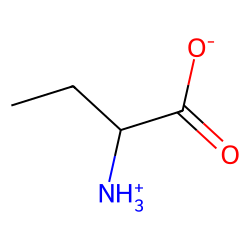
- InChI
- InChI=1S/C4H9NO2/c1-2-3(5)4(6)7/h3H,2,5H2,1H3,(H,6,7)
- InChI Key
- QWCKQJZIFLGMSD-UHFFFAOYSA-N
- Formula
- C4H9NO2
- SMILES
- CCC([NH3+])C(=O)[O-]
- Molecular Weight1
- 103.12
- CAS
- 2835-81-6
- Other Names
-
- (.+-.)-.alpha.-aminobutyric acid
- (±)-2-aminobutyric acid
- 2-Aminobutyric acid
- 2-Aminobutyric acid, dl
- Aminobutyric acid,-2-
- Butanoic acid, 2-amino-
- Butanoic acid, 2-amino-, (.+/-.)-
- Butyric acid, 2-amino-, DL-
- Butyric acid, dl-2-amino-, beta-form
- Butyrine
- DL-.alpha.-amino-n-butyric acid
- DL-.alpha.-aminobutanoic acid
- DL-.alpha.-aminobutyric acid
- DL-2-amino-n-butyric acid
- DL-2-aminobutanoic acid
- NSC 3251
- alpha-Aminobutyric acid
- butanoic acid, 2-amino-, (.+-.)-
- dl-«alpha»-Amino-n-butyric acid
- «alpha»-Aminobutyric acid
- ΔcH°solid : Standard solid enthalpy of combustion (kJ/mol).
- ΔfH°solid : Solid phase enthalpy of formation at standard conditions (kJ/mol).
- ΔsubH : Enthalpy of sublimation at a given temperature (kJ/mol).
- IE : Ionization energy (eV).
- log10WS : Log10 of Water solubility in mol/l.
- logPoct/wat : Octanol/Water partition coefficient.
- McVol : McGowan's characteristic volume (ml/mol).
- Tboil : Normal Boiling Point Temperature (K).
- Tfus : Normal melting (fusion) point (K).
- 1: Molecular weight from the IUPAC atomic weights tables.
Physical Properties
| Property | Value | Unit | Source |
|---|---|---|---|
| ΔcH°solid | -2254.00 ± 1.10 | kJ/mol | NIST |
| ΔfH°solid | -605.80 ± 1.10 | kJ/mol | NIST |
| IE | 9.79 | eV | Relay (1.0) Calculated Property |
| log10WS | 0.31 | Aq. Solubility Prediction | |
| logPoct/wat | -2.243 | Crippen Calculated Property | |
| McVol | 84.640 | ml/mol | McGowan Calculated Property |
| Tboil | 391.41 | K | Relay (1.0) Calculated Property |
| Tfus | 577.15 | K | Jean-Claude Bradley Open Melting Point Dataset (2014, CC0) Compiled value |
Cheméo can also estimate Critical Temperature, Critical Pressure, Critical Volume, Enthalpy of formation at standard conditions, Enthalpy of vaporization at standard conditions, Standard Gibbs free energy of formation, Acentric Factor for this compound, but they fall outside the models' validated range, so they are not shown here. Open the prediction tool to compute them on demand.
Temperature Dependent Properties
| Property | Value | Unit | Temperature (K) | Source |
|---|---|---|---|---|
| ΔsubH | [132.00; 132.00] | kJ/mol | [409.00; 409.00] | 
|
| ΔsubH | 132.00 | kJ/mol | 409.00 | NIST |
| ΔsubH | 132.00 ± 2.00 | kJ/mol | 409.00 | NIST |

Similar Compounds


Find more compounds similar to dl-2-Aminobutyric acid.
Mixtures
- dl-2-Aminobutyric acid + Water + Tetradonium Bromide
- dl-2-Aminobutyric acid + Water
- Betaine + dl-2-Aminobutyric acid + Water
- dl-2-Aminobutyric acid + sodium chloride + Water
- dl-2-Aminobutyric acid + N-Methylglycine + Water
- dl-2-Aminobutyric acid + Magnesium acetate + Water
- dl-2-Aminobutyric acid + Water + Methanamine, N,N-dimethyl-, N-oxide
- dl-2-Aminobutyric acid + Lithium chloride + Water
- potassium chloride + dl-2-Aminobutyric acid + Water
- Ammonium sulfate + dl-2-Aminobutyric acid + Water
- dl-2-Aminobutyric acid + sodium sulphate + Water
- dl-2-Aminobutyric acid + Zinc Chloride + Water
- dl-2-Aminobutyric acid + Acetic acid, sodium salt + Water
- dl-2-Aminobutyric acid + 1,2-Ethanediol + Dimethyl Sulfoxide
- dl-2-Aminobutyric acid + 1,2-Ethanediol
- dl-2-Aminobutyric acid + Dimethyl Sulfoxide
Sources
- Jean-Claude Bradley Open Melting Point Dataset (2014, CC0) ChEDL chemicals 1.5.2, from Bradley, J.-C.; Williams, A.; Lang, A. Jean-Claude Bradley Open Melting Point Dataset. Figshare, 2014 (CC0).
- Cheméo Relay (1.0)
- Cheméo Relay (1.0, beta) Beta: served but experimental, data-limited and below our cross-validation release bar; the Joback value is recommended where available.
- Crippen Method
- Osmotic and activity coefficients of glycine, dl-a-alanine and dl-a-aminobutyric acid in aqueous solutions at temperatures between 288.15 and 303.15 K
- Effect of sodium caproate on the volumetric and viscometric properties of glycine, DL-alpha-alanine, and DL-alpha-amino-n-butyric acid in aqueous solutions
- Effect of magnesium acetate on the volumetric and transport behavior of some amino acids in aqueous solutions at 298.15 K
- The vapour pressures over saturated aqueous solutions of DL-2-aminobutyric acid, 4-aminobutyric acid, sodium-D-gluconate, sodium hippurate, and potassium magnesium-L-aspartate
- Thermodynamics of the interactions of a homologous series of some amino acids with trimethylamine N-oxide: Volumetric, compressibility, and calorimetric studies
- Interaction of homologous series of amino acids with sarcosine in presence of denaturant: Volumetric and calorimetric approach
- Thermodynamics of the interactions of some amino acids and peptides with dodecyltrimethylammonium bromide and tetradecyltrimethylammonium bromide
- Effect of glycine, DL-alanine and DL-2-aminobutyric acid on the temperature of maximum density of water
- Effect of temperature on the partial molar volume, isentropic compressibility and viscosity of DL-2-aminobutyric acid in water and in aqueous sodium chloride solutions
- Mode of action of betaine on some amino acids and globular proteins: Thermodynamic considerations
- Molecular interactions of some amino acids in aqueous 1-butyl-3-methylimidazolium bromide solutions at different temperatures: A volumetric approach
- Diffusion and structural behaviour of the DL-2-aminobutyric acid
- Surface Tension of Glycine, Alanine, Aminobutyric Acid, Norvaline, and Norleucine in Water and in Aqueous Solutions of Strong Electrolytes at Temperatures from (293.15 to 313.15) K
- Apparent Molar Volumes and Viscosities of Some Amino Acids in Aqueous Sodium Acetate Solutions at 298.15 K
- Partial Molar Volumes and Viscosities of Some r-Amino Acids in Micellar Solutions of Sodium Caprylate
- Infinite Dilution Binary Diffusion Coefficients of Several r-Amino Acids in Water over a Temperature Range from (293.2 to 333.2) K with the Taylor Dispersion Technique
- Volumetric and Viscometric Studies of Some Amino Acids in Aqueous Solutions of Cadmium Chloride at T = (288.15 to 318.15) K and at Atmospheric Pressure
- Binary Diffusion Coefficients of Aqueous Phenylalanine, Tyrosine Isomers, and Aminobutyric Acids at Infinitesimal Concentration and Temperatures from (293.2 to 333.2) K
- Excess Volume of Water in Hydrate Complexes of Some alpha-Amino Acids
- Solubility and Solvation Thermodynamics of a Series of Homologous a-Amino Acids in Nonaqueous Binary Mixtures of Ethylene Glycol and Dimethyl Sulfoxide
- Study of Interactions between Amino Acids and Zinc Chloride in Aqueous Solutions through Volumetric Measurements at T ) (288.15 to 318.15) K
- Aqueous Solubility Prediction Method
- McGowan Method
- NIST Webbook
Note: Cheméo is only indexing the data, follow the source links to retrieve the latest data. The source is also providing more information like the publication year, authors and more.
Take the time to validate and double check the source of the data.
Calculated This icon marks a calculated value or equation: a prediction, not a measurement.
Compiled This icon marks a compiled value or equation: taken from a data compilation such as ChemSep, not from an original measurement report.
These property values are available through the Cheméo API. A free account gives you an access key.