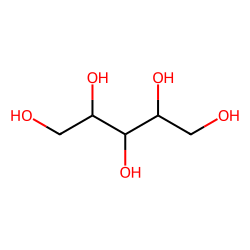
- InChI
- InChI=1S/C5H12O5/c6-1-3(8)5(10)4(9)2-7/h3-10H,1-2H2/t3-,4+,5+
- InChI Key
- HEBKCHPVOIAQTA-SCDXWVJYSA-N
- Formula
- C5H12O5
- SMILES
- OCC(O)C(O)C(O)CO
- Molecular Weight1
- 152.15
- CAS
- 87-99-0
- Other Names
-
- klinit
- kylit
- xylite
- xyliton
- ΔcH°liquid : Standard liquid enthalpy of combustion (kJ/mol).
- Cp,gas : Ideal gas heat capacity (J/mol×K).
- η : Dynamic viscosity (Pa×s).
- ΔfH°gas : Enthalpy of formation at standard conditions (kJ/mol).
- ΔfH°liquid : Liquid phase enthalpy of formation at standard conditions (kJ/mol).
- ΔfusH° : Enthalpy of fusion at standard conditions (kJ/mol).
- ΔfusH : Enthalpy of fusion at a given temperature (kJ/mol).
- ΔsubH° : Enthalpy of sublimation at standard conditions (kJ/mol).
- ΔvapH° : Enthalpy of vaporization at standard conditions (kJ/mol).
- ΔvapH : Enthalpy of vaporization at a given temperature (kJ/mol).
- log10WS : Log10 of Water solubility in mol/l.
- logPoct/wat : Octanol/Water partition coefficient.
- McVol : McGowan's characteristic volume (ml/mol).
- Pc : Critical Pressure (kPa).
- ΔfusS : Entropy of fusion at a given temperature (J/mol×K).
- Tboil : Normal Boiling Point Temperature (K).
- Tc : Critical Temperature (K).
- Tfus : Normal melting (fusion) point (K).
- Vc : Critical Volume (m3/kmol).
- 1: Molecular weight from the IUPAC atomic weights tables.
Cheméo is a service of Céondo GmbH, since 2007, we provide simulation, modelling and software development services for the industry.
Do not hesitate to contact us for your projects.
Physical Properties

Cheméo can also estimate Standard Gibbs free energy of formation, Acentric Factor, Ionization energy for this compound, but they fall outside the models' validated range, so they are not shown here. Open the prediction tool to compute them on demand.
Temperature Dependent Properties
| Property | Value | Unit | Temperature (K) | Source |
|---|---|---|---|---|
| ΔfusH | [33.26; 37.70] | kJ/mol | [365.70; 369.00] | 
|
| ΔfusH | 37.40 | kJ/mol | 365.70 | NIST |
| ΔfusH | 37.40 | kJ/mol | 365.70 | NIST |
| ΔfusH | 37.70 | kJ/mol | 368.00 | NIST |
| ΔfusH | 33.26 | kJ/mol | 369.00 | NIST |
| ΔvapH | 111.10 ± 0.80 | kJ/mol | 433.00 | NIST |
| ΔfusS | 102.30 | J/mol×K | 365.70 | NIST |
Correlations
| Property | Value | Unit | Temperature (K) | Source |
|---|---|---|---|---|
| Cp,gas | [173.11; 372.25] | J/mol×K | [273.00; 1000.00] |
Joback Predicted correlation
|
| Equation | Y = A + B·T + C·T² + D·T³ + E·T⁴ Y is Cp,gas in J/mol×K, T in K | |||
| Coefficient A | 1.97520e+01 | |||
| Coefficient B | 6.66500e-01 | |||
| Coefficient C | -4.09800e-04 | |||
| Coefficient D | 9.58000e-08 | |||
| Coefficient E | 0.00000e+00 | |||
| Temperature range, min. | 273.00 | |||
| Temperature range, max. | 1000.00 | |||
| Cp,gas | 173.11 | J/mol×K | 273.00 | Calculated Property |
| Cp,gas | 208.50 | J/mol×K | 353.78 | Calculated Property |
| Cp,gas | 239.86 | J/mol×K | 434.56 | Calculated Property |
| Cp,gas | 267.50 | J/mol×K | 515.33 | Calculated Property |
| Cp,gas | 291.73 | J/mol×K | 596.11 | Calculated Property |
| Cp,gas | 312.85 | J/mol×K | 676.89 | Calculated Property |
| Cp,gas | 331.16 | J/mol×K | 757.67 | Calculated Property |
| Cp,gas | 346.96 | J/mol×K | 838.44 | Calculated Property |
| Cp,gas | 360.55 | J/mol×K | 919.22 | Calculated Property |
| Cp,gas | 372.25 | J/mol×K | 1000.00 | Calculated Property |
| Property | Value | Unit | Temperature (K) | Source |
|---|---|---|---|---|
| η | [0.0888743; 0.0000008] | Pa×s | [366.81; 663.46] |
Joback Predicted correlation
|
| Equation | Y = exp(A + B/T + C·ln(T) + D·T^E) Y is η in Pa×s, T in K | |||
| Coefficient A | -2.82992e+01 | |||
| Coefficient B | 9.49265e+03 | |||
| Coefficient C | 0.00000e+00 | |||
| Coefficient D | 0.00000e+00 | |||
| Coefficient E | 0.00000e+00 | |||
| Comment | Liquid phase. Joback/Reid (1987), valid from Tf to 0.7·Tc. | |||
| Temperature range, min. | 366.81 | |||
| Temperature range, max. | 663.46 | |||
| η | 0.0888743 | Pa×s | 366.81 | Calculated Property |
| η | 0.0105230 | Pa×s | 399.78 | Calculated Property |
| η | 0.0017245 | Pa×s | 432.74 | Calculated Property |
| η | 0.0003651 | Pa×s | 465.70 | Calculated Property |
| η | 0.0000949 | Pa×s | 498.66 | Calculated Property |
| η | 0.0000292 | Pa×s | 531.62 | Calculated Property |
| η | 0.0000103 | Pa×s | 564.58 | Calculated Property |
| η | 0.0000041 | Pa×s | 597.54 | Calculated Property |
| η | 0.0000018 | Pa×s | 630.50 | Calculated Property |
| η | 0.0000008 | Pa×s | 663.46 | Calculated Property |
Similar Compounds


Find more compounds similar to Xylitol.
Mixtures
- Dimethyl Sulfoxide + Xylitol
- Xylitol + Water
- Tetrahydrofuran + Xylitol + Water
- Vitamin C + Xylitol + Water
- Xylitol + Water + Cetrimonium Bromide
- Xylitol + Water + Glycine, N-(carboxymethyl)-
- Ethanol + Xylitol
- Acetone + Xylitol
- Ethanol + Acetone + Xylitol
- Glycine + Xylitol + Water
- D-Alanine + Xylitol + Water
- D-Valine + Xylitol + Water
- Threonine + Xylitol + Water
- (-)-D-arginine hydrate + Xylitol + Water
- Xylitol + Water + Ammonium bromide
- Tetraethylammonium bromide + Xylitol + Water
- Xylitol + Water + N,N'-DIACETYLHEXAMETHYLENEDIAMINE
- Formamide, N,N-dimethyl- + Xylitol
- 1-Butanol + Xylitol
- 1-Pentanol + Xylitol
Find more mixtures with Xylitol.
Sources
- Cheméo Relay (1.0)
- Crippen Method
- Crippen Method
- Solid-liquid phase equilibria in binary mixtures of functionalized ionic liquids with sugar alcohols: New experimental data and modelling
- Osmotic properties of carbohydrate aqueous solutions
- Partitioning of diuron in a novel aqueous two-phase system based on polyols and tetrahydrofuran
- Experimental and in silico characterization of xylitol as seasonal heat storage material
- Apparent molar volumes and apparent molar heat capacities of aqueous adonitol, dulcitol, glycerol, meso-erythritol, myo-inositol, D-sorbitol, and xylitol at temperatures from (278.15 to 368.15) K and at the pressure 0.35 MPa
- Enthalpy of dilution and volumetric properties of N-glycylglycine in aqueous xylitol solutions at T = 298.15 K
- Solubility of xylitol and sorbitol in ionic liquids - Experimental data and modeling
- Solubility data and modeling for sugar alcohols in ionic liquids
- Investigations to explore interactions in (polyhydroxy solute + L-ascorbic acid + H2O) solutions at different temperatures: Calorimetric and viscometric approach
- Volumetric, viscometric and 1H NMR spectroscopic studies in (polyhydroxy solute + CTAB + H2O) ternary solutions
- Heat capacities of some sugar alcohols as phase change materials for thermal energy storage applications
- Thermodynamic investigation of several natural polyols (I): Heat capacities and thermodynamic properties of xylitol
- Dielectric relaxation and thermodynamic study of polyhydric sugar alcohols in DMSO using TDR technique
- Densities and Viscosities of Sugar Alcohols in Vitamin B6 Aqueous Solutions at (293.15 to 323.15) K
- Densities and Viscosities of Polyhydroxy Solutes in Aqueous Tetraethylammonium Bromide Solutions at Different Temperatures
- Densities and viscosities of amino acid + xylitol + water solutions at 293.15 less than T/K greater than 323.15
- Molecular Interactions of Saccharides and Their Derivatives with Thiamine HCl and Pyridoxine HCl Vitamins in Aqueous Solutions: Calorimetric, Viscometric, and NMR Spectroscopic Studies
- Solubility Behavior and Data Modeling of l-Proline in Different Neat and Binary Solvent Systems
- Solubility of Xylitol in Ethanol, Acetone, N,N-Dimethylformamide, 1-Butanol, 1-Pentanol, Toluene, 2-Propanol, and Water
- Enthalpies of Dilution, Volumetric Properties, and Refractive Indices of N,N'-Hexamethylenebisacetamide in Aqueous Xylitol or d-Mannitol Solutions at T = 298.15 K
- Ionic Liquids as Promising Solvents for Biomass Derived Mannitol and Xylitol
- Densities and Viscosities of Erythritol, Xylitol, and Mannitol in l-ascorbic Acid Aqueous Solutions at T = (293.15 to 323.15) K
- Density of Mixtures Containing Sugars and Ionic Liquids: Experimental Data and PC-SAFT Modeling
- Influence of NH4Br on Solvation Behavior of Polyhydroxy Solutes in Aqueous Solutions at Different Temperatures and Atmospheric Pressure
- Measurement and Correlation of Solubility of Xylitol in Binary Ethanol + Acetone Solvent Mixtures with the Combined Nearly Ideal Binary Solvent/ Redlich-Kister Equation
- Properties of Sugar, Polyol, and Polysaccharide Water-Ethanol Solutions
- Transfer Enthalpies of Amino Acids and Glycine Peptides from Water to Aqueous Solutions of Sugar Alcohol at 298.15 K
- Densities and Viscosities of Sugar Alcohol Aqueous Solutions
- Joback Method
- McGowan Method
- NIST Webbook
Note: Cheméo is only indexing the data, follow the source links to retrieve the latest data. The source is also providing more information like the publication year, authors and more.
Take the time to validate and double check the source of the data.
These property values are available through the Cheméo API. A free account gives you an access key.