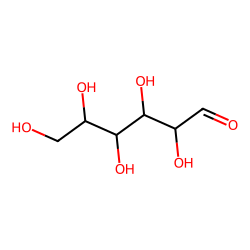
- InChI
- InChI=1S/C6H12O6/c7-1-3(9)5(11)6(12)4(10)2-8/h1,3-6,8-12H,2H2/t3-,4+,5+,6-/m0/s1
- InChI Key
- GZCGUPFRVQAUEE-KCDKBNATSA-N
- Formula
- C6H12O6
- SMILES
- O=CC(O)C(O)C(O)C(O)CO
- Molecular Weight1
- 180.16
- CAS
- 26566-61-0
- Other Names
-
- (+)-galactose
- D(+)-galactose
- D-(+)-galactose
- D-galactose
- Galactose, D-
- Cp,gas : Ideal gas heat capacity (J/mol×K).
- Cp,solid : Solid phase heat capacity (J/mol×K).
- η : Dynamic viscosity (Pa×s).
- ΔfusH° : Enthalpy of fusion at standard conditions (kJ/mol).
- ΔvapH° : Enthalpy of vaporization at standard conditions (kJ/mol).
- log10WS : Log10 of Water solubility in mol/l.
- logPoct/wat : Octanol/Water partition coefficient.
- McVol : McGowan's characteristic volume (ml/mol).
- Tboil : Normal Boiling Point Temperature (K).
- Tfus : Normal melting (fusion) point (K).
- 1: Molecular weight from the IUPAC atomic weights tables.
Physical Properties
| Property | Value | Unit | Source |
|---|---|---|---|
| ΔfusH° | 19.93 | kJ/mol | Joback Calculated Property |
| ΔvapH° | 117.40 | kJ/mol | Relay (1.0) Calculated Property |
| log10WS | 0.76 | Relay (1.0) Calculated Property | |
| logPoct/wat | -3.379 | Crippen Calculated Property | |
| McVol | 126.320 | ml/mol | McGowan Calculated Property |
| Tboil | 622.14 | K | Relay (1.0) Calculated Property |
| Tfus | 399.99 | K | Relay (1.0) Calculated Property |
Cheméo can also estimate Critical Temperature, Critical Pressure, Critical Volume, Enthalpy of formation at standard conditions, Standard Gibbs free energy of formation, Acentric Factor, Ionization energy for this compound, but they fall outside the models' validated range, so they are not shown here. Open the prediction tool to compute them on demand.
Temperature Dependent Properties

Correlations
| Property | Value | Unit | Temperature (K) | Source |
|---|---|---|---|---|
| Cp,gas | [198.92; 415.16] | J/mol×K | [273.00; 1000.00] |
Joback Predicted correlation

|
| Equation | Y = A + B·T + C·T² + D·T³ + E·T⁴ Y is Cp,gas in J/mol×K, T in K | |||
| Coefficient A | 2.85610e+01 | |||
| Coefficient B | 7.41900e-01 | |||
| Coefficient C | -4.60400e-04 | |||
| Coefficient D | 1.05100e-07 | |||
| Coefficient E | 0.00000e+00 | |||
| Temperature range, min. | 273.00 | |||
| Temperature range, max. | 1000.00 | |||
| Cp,gas | 198.92 | J/mol×K | 273.00 | Calculated Property |
| Cp,gas | 238.06 | J/mol×K | 353.78 | Calculated Property |
| Cp,gas | 272.64 | J/mol×K | 434.56 | Calculated Property |
| Cp,gas | 303.00 | J/mol×K | 515.33 | Calculated Property |
| Cp,gas | 329.48 | J/mol×K | 596.11 | Calculated Property |
| Cp,gas | 352.39 | J/mol×K | 676.89 | Calculated Property |
| Cp,gas | 372.09 | J/mol×K | 757.67 | Calculated Property |
| Cp,gas | 388.89 | J/mol×K | 838.44 | Calculated Property |
| Cp,gas | 403.14 | J/mol×K | 919.22 | Calculated Property |
| Cp,gas | 415.16 | J/mol×K | 1000.00 | Calculated Property |
| Property | Value | Unit | Temperature (K) | Source |
|---|---|---|---|---|
| η | [0.0017994; 0.0000003] | Pa×s | [443.48; 723.98] |
Joback Predicted correlation
|
| Equation | Y = exp(A + B/T + C·ln(T) + D·T^E) Y is η in Pa×s, T in K | |||
| Coefficient A | -2.84572e+01 | |||
| Coefficient B | 9.81726e+03 | |||
| Coefficient C | 0.00000e+00 | |||
| Coefficient D | 0.00000e+00 | |||
| Coefficient E | 0.00000e+00 | |||
| Temperature range, min. | 443.48 | |||
| Temperature range, max. | 723.98 | |||
| η | 0.0017994 | Pa×s | 443.48 | Calculated Property |
| η | 0.0004206 | Pa×s | 474.65 | Calculated Property |
| η | 0.0001176 | Pa×s | 505.81 | Calculated Property |
| η | 0.0000381 | Pa×s | 536.98 | Calculated Property |
| η | 0.0000140 | Pa×s | 568.15 | Calculated Property |
| η | 0.0000057 | Pa×s | 599.32 | Calculated Property |
| η | 0.0000025 | Pa×s | 630.48 | Calculated Property |
| η | 0.0000012 | Pa×s | 661.65 | Calculated Property |
| η | 0.0000006 | Pa×s | 692.82 | Calculated Property |
| η | 0.0000003 | Pa×s | 723.98 | Calculated Property |
Similar Compounds


Find more compounds similar to Galactose.
Mixtures
- Galactose + Water
- Galactose + Vitamin C + Water
- Magnesium chloride + Galactose + Water
- potassium chloride + Galactose + Water
- Galactose + caesium chloride + Water
- Galactose + Water + 1,4,7,10,13,16-Hexaoxacyclooctadecane
- Galactose + Water + diphenhydramine hydrochloride
- Galactose + Water + Acetic acid, sodium salt, hydrate (1:1:3)
- Galactose + Glycine + Water
- D-Alanine + Galactose + Water
- Galactose + N-Glycylglycine + Water
- Galactose + Lithium chloride + Water
- Galactose + Fructose + Water
- Galactose + Glucose + Water
- Sucrose + Galactose + Water
- Galactose + Water + Ammonium bromide
- Galactose + Water + Sodium borate
- Galactose + Tetraethylammonium bromide + Water
- Galactose + Ethanol + Water
- Galactose + Ethanol
Find more mixtures with Galactose.
Sources
- Cheméo Relay (1.0)
- Cheméo Relay (1.0, beta) Beta: served but experimental, data-limited and below our cross-validation release bar; the Joback value is recommended where available.
- Crippen Method
- Crippen Method
- Physicochemical Behavior of Some Amino Acids/Glycylglycine in Aqueous D-Galactose Solutions at Different Temperatures
- Solubility of monosaccharides in ionic liquids - Experimental data and modeling
- Conductivities of 1-alkyl-3-methylimidazolium chloride ionic liquids in monosaccharide + water solutions at 298.15 K
- Conductivity in MnSO4-saccharide-water solutions at 298.15 K
- Solubility of glucose, xylose, fructose and galactose in ionic liquids: Experimental and theoretical studies using a continuum solvation model
- Osmotic properties of carbohydrate aqueous solutions
- Volumetric properties and volumetric interaction parameters for the CsCl-monosaccharide (D-galactose, D-xylose and D-arabinose)-water systems at T = 298.15 K
- Temperature dependence of the heat capacities in the solid state of 18 mono-, di-, and poly-saccharides
- Studies on volumetric properties of some saccharides in aqueous potassium chloride solutions over temperature range (288.15 to 318.15) K
- Effect of sodium acetate on the volumetric behaviour of some mono-, di-, and tri-saccharides in aqueous solutions over temperature range (288.15 to 318.15) K
- Viscometric studies on saccharides in aqueous magnesium chloride solutions at T = (288.15 to 318.15) K
- Investigations to explore interactions in (polyhydroxy solute + L-ascorbic acid + H2O) solutions at different temperatures: Calorimetric and viscometric approach
- Effect of fruit and milk sugars on solute-solvent interactions of diphenhydramine-hydrochloride drug in aqueous solutions in viewpoint of volumetric and transport properties
- Selective interactions of 18-crown-6 with d-glucose and d-galactose in aqueous solutions: Titration calorimetry, densimetry, viscosimetry
- Thermochemical behavior of 18-crown-6 in aqueous solutions of some monosaccharides
- Densities and Viscosities of Polyhydroxy Solutes in Aqueous Tetraethylammonium Bromide Solutions at Different Temperatures
- Measurement and Correlation of Liquid Liquid Equilibria for the Ternary Systems of Water + d-Fructose + 1-Butanol, Water + d-Glucose + 1-Butanol, and Water + d-Galactose + 1-Butanol at (288.2, 303.2 and 318.2) K
- Measurements and Correlation of Water Activity in Aqueous Solutions Containing Diphenhydramine-Hydrochloride Drug, (D+)-Galactose, (D-)-Fructose, (D+)-Lactose, and Sucrose at 298.15 K
- Volumetric and Viscosity Properties of Monosaccharides in Aqueous Amino Acid Solutions at 298.15 K
- Infinite Dilution Binary Diffusion Coefficients for Six Sugars at 0.1 MPa and Temperatures from (273.2 to 353.2) K
- Solubilities of Protocatechuic Aldehyde, Caffeic Acid, d-Galactose, and d-Raffinose Pentahydrate in Ethanol Water Solutions
- Volumetric and Viscometric Studies on Saccharide-Disodium Tetraborate (Borax) Interactions in Aqueous Solutions
- Studies on the Interactions of Saccharides and Methyl Glycosides with Lithium Chloride in Aqueous Solutions at (288.15 to 318.15) K
- Influence of NH4Br on Solvation Behavior of Polyhydroxy Solutes in Aqueous Solutions at Different Temperatures and Atmospheric Pressure
- Viscosity of Multicomponent Solutions of Simple and Complex Sugars in Water
- Relative Permittivities for the Galactose + Glycine + Water Solution from (278.15 to 313.15) K
- Joback Method
- McGowan Method
- NIST Webbook
Note: Cheméo is only indexing the data, follow the source links to retrieve the latest data. The source is also providing more information like the publication year, authors and more.
Take the time to validate and double check the source of the data.
These property values are available through the Cheméo API. A free account gives you an access key.